Story Summary
Discover the tragic tale of Clytemnestra's Revenge. Agamemnon returns from the Trojan War only to face his wife’s deadly wrath for his past betrayals.
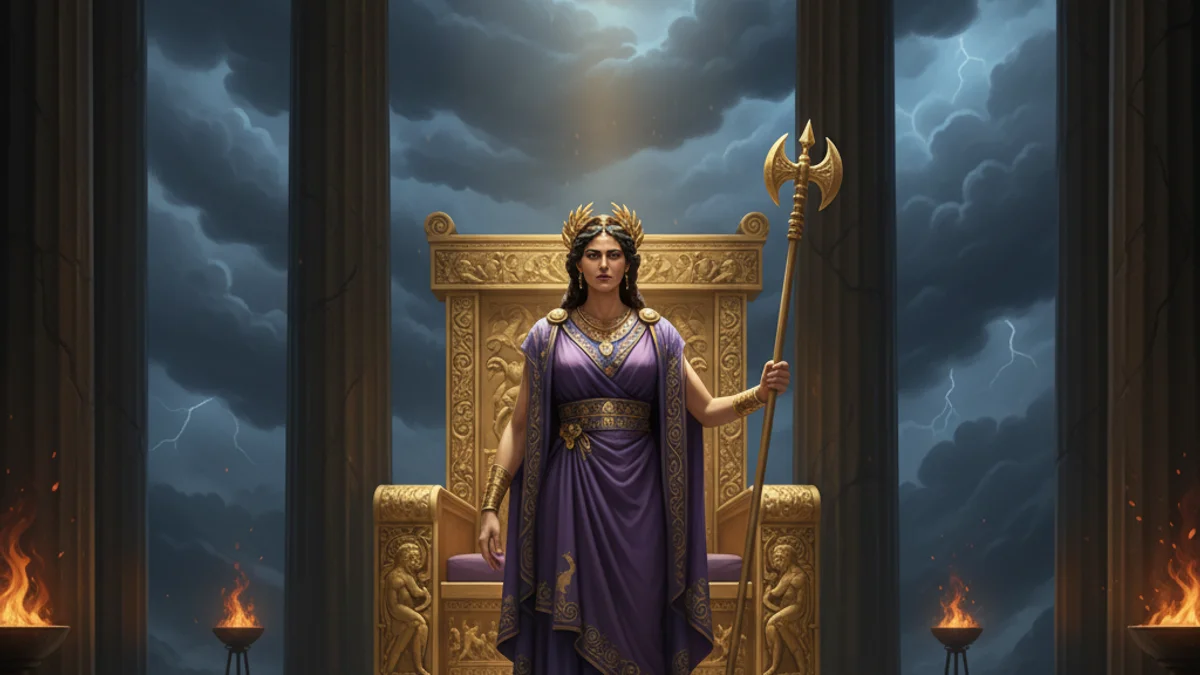
When King Agamemnon returned to Mycenae as the victor of the Trojan War, he expected a hero's welcome. However, Queen Clytemnestra had spent ten years nursing a singular, icy hatred. She could not forget that Agamemnon had sacrificed their eldest daughter, Iphigenia, to secure favorable winds for his fleet. While Agamemnon was away, Clytemnestra took a lover, Aegisthus, and plotted her husband's demise. Upon his arrival, she greeted him with deceptive grace, spreading purple tapestries for him to walk upon. As Agamemnon relaxed in a ritual bath, Clytemnestra entangled him in a heavy, weighted robe that functioned like a net. Defenseless, the King was struck down by his wife's axe. Clytemnestra stood over his body, unrepentant, claiming she had finally balanced the scales of justice for her lost child, though her actions would only invite further cycles of blood and vengeance.
The Moral
Vengeance often creates a self-perpetuating cycle of violence that destroys both the guilty and the seeker of justice.
“The sea is there, and who shall drain it dry? It yields the purple dye for many a robe.”
Fun Fact
In Aeschylus' play 'Agamemnon', Clytemnestra is described as having a 'man-counseling heart', highlighting her unusual power and agency compared to other women in Greek literature.
Frequently Asked Questions
Why did Clytemnestra kill Agamemnon?
She killed him primarily to avenge their daughter, Iphigenia, whom Agamemnon sacrificed to the goddess Artemis to gain favorable winds for the Greek fleet sailing to Troy.
Who helped Clytemnestra carry out the murder?
Clytemnestra was aided by her lover, Aegisthus, who also had a grudge against Agamemnon’s family due to a long-standing blood feud between their fathers.
What happened to Cassandra in this story?
Cassandra, the Trojan prophetess brought back by Agamemnon as a concubine, was also murdered by Clytemnestra shortly after the King was killed.
How did Clytemnestra trap Agamemnon?
She used a weighted, sleeveless robe or a heavy net to entangle him while he was in the bath, rendering him unable to defend himself or reach for a weapon.
Is Clytemnestra considered a villain or a victim?
Interpretations vary; some see her as a cold-blooded murderer and adulteress, while others view her as a grieving mother driven to extreme measures by her husband's betrayal.
Who eventually avenged Agamemnon's death?
Years later, Agamemnon's son, Orestes, returned to Mycenae to kill both Clytemnestra and Aegisthus, continuing the tragic cycle of the House of Atreus.
Discussion (0)
Share your thoughts on this story
No comments yet. Be the first to share your thoughts!