Story Summary
Explore the chilling tale of Rokuro-kubi the Long-Necked Woman, a Japanese legend of ordinary women who transform at night into stretching supernatural yokai.
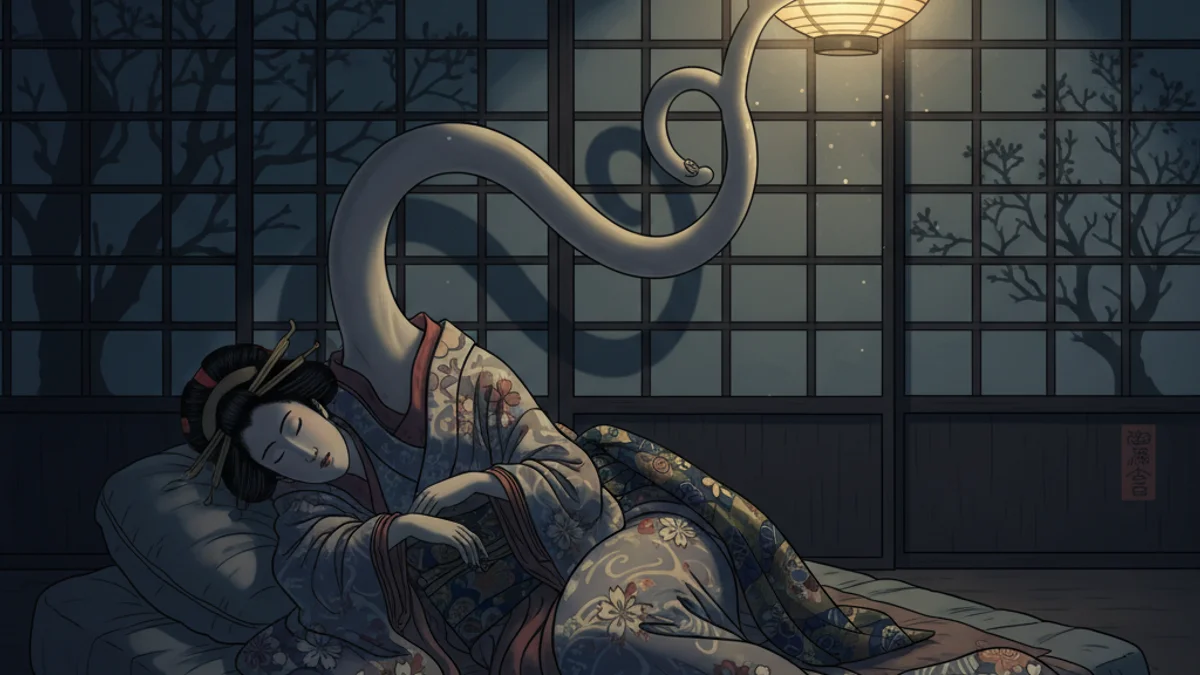
By day, the Rokuro-kubi lived as an ordinary woman, blending into the quiet streets of old Edo. She was a dutiful wife, her face painted white and her kimono impeccable. However, as the moon rose and sleep claimed the household, a strange transformation occurred. While her body remained still under the futon, her neck began to stretch like a coiling snake. Her head glided through the shadows of the house, licked the oil from the andon lamps, and peered into the forbidden corners of the night. In many tales, these women were victims of a curse or a spiritual disease called hitobanama, often caused by the sins of their fathers or husbands. One famous story tells of a man who woke to find his wife’s body headless, only to discover her face floating near the rafters, whispering to the moon. When dawn approached, the neck retracted, and the woman woke with no memory of her nocturnal wanderings, though she often felt a strange stiffness in her shoulders and a lingering thirst.
The Moral
True nature cannot be hidden forever, and the actions of our ancestors can cast long, strange shadows over our lives.
“The neck that stretches towards the moon reveals the secrets the heart keeps hidden by day.”
Fun Fact
During the Edo period, some traveling shows attempted to use optical illusions to convince audiences they were seeing a real Rokuro-kubi in the flesh.
Frequently Asked Questions
What is the difference between a Rokuro-kubi and a Nukekubi?
The Rokuro-kubi features a neck that stretches to immense lengths while remaining attached, whereas the Nukekubi's head detaches completely and flies independently through the air.
Why do Rokuro-kubi necks stretch at night?
In folklore, it is often attributed to a spiritual illness or a karmic curse resulting from the woman's own hidden desires or the misdeeds of her family members.
Are Rokuro-kubi dangerous to humans?
They are generally portrayed as mischievous rather than predatory. While they might startle people or lick lamp oil, they rarely cause physical harm unless they are the more malevolent Nukekubi variety.
How can you identify a Rokuro-kubi during the day?
According to legend, they look perfectly human during the day, though some versions suggest they have faint white lines or stretch marks around their necks.
What is the origin of the Rokuro-kubi legend?
These creatures became popular in the Edo period of Japan, appearing frequently in ghost story collections known as Kaidan and woodblock prints used to entertain and frighten the public.
Can the curse of the Rokuro-kubi be broken?
Some stories suggest that the condition can be cured by a powerful monk through prayer or by finding a way to atone for the ancestral sins that caused the transformation.
Discussion (0)
Share your thoughts on this story
No comments yet. Be the first to share your thoughts!