
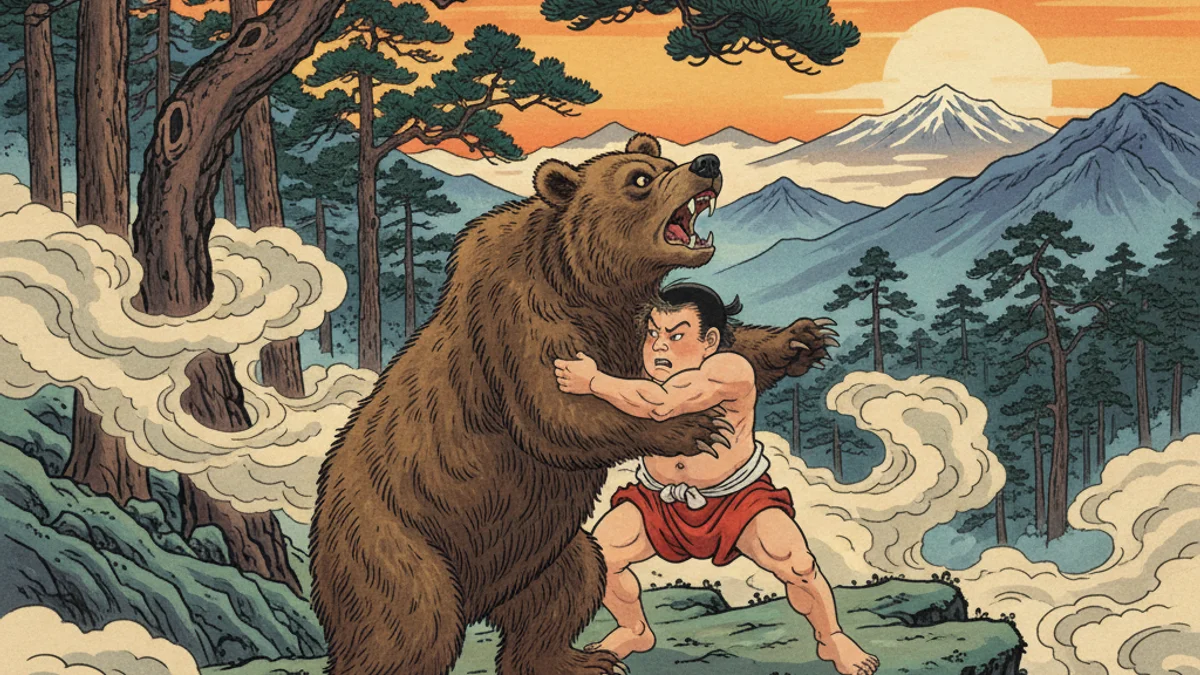
On the misty slopes of Mount Ashigara lived a boy of extraordinary strength named Kintaro. Raised by his mother in the wild, the 'Golden Boy' spent his days befriending the creatures of the forest. Clad in a simple red bib marked with the character for 'gold,' he wrestled bears for sport and uprooted giant trees to bridge mountain streams for his animal companions. His kindness was as vast as his power; he never used his strength to bully, only to protect and help. One day, the great samurai Minamoto no Yorimitsu witnessed Kintaro’s incredible feat of toppling a massive cedar. Impressed by the boy’s spirit and might, the lord invited him to the capital. Kintaro bid farewell to his animal friends and mother, eventually transforming into the legendary warrior Sakata no Kintoki, one of the Four Guardian Kings of Japan.
True greatness lies in combining immense physical strength with a kind and gentle heart toward all living things.
Questions about this story
What is the moral of Kintaro the Golden Boy?
The story teaches that physical power is most noble when paired with kindness and used to protect the weak. It emphasizes the importance of courage and a gentle spirit.
Who was Kintaro in real life?
Kintaro is based on a historical figure named Sakata no Kintoki, a legendary samurai who served under Minamoto no Yorimitsu during the Heian period.
Why is Kintaro associated with Children's Day in Japan?
Kintaro dolls are displayed on Children's Day (Tango no Sekku) to inspire boys to grow up healthy, strong, and brave like the Golden Boy.
What does Kintaro traditionally wear?
He is typically depicted wearing only a red 'haragake' or bib, featuring the kanji character 'Kin' (gold), which symbolizes his name and status.
Advertisement



Good night.
