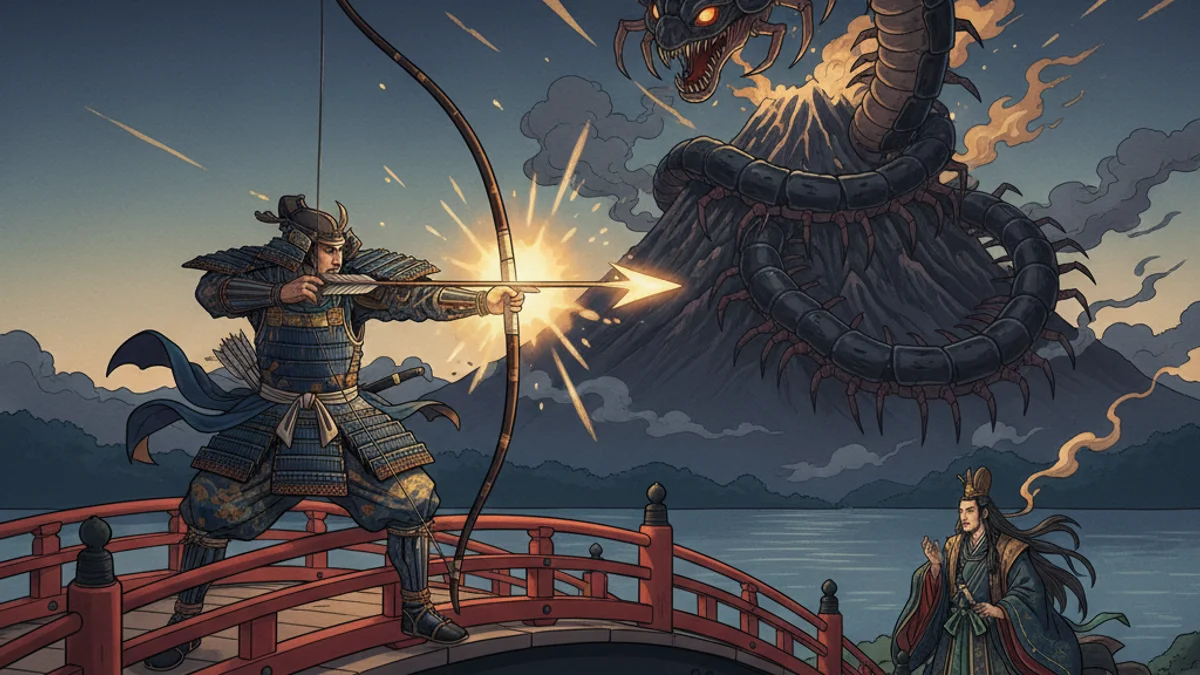
Fujiwara no Hidesato, a brave warrior, was crossing the Seta Bridge over Lake Biwa when he encountered a massive dragon lying across his path. Unlike others who fled in terror, Hidesato calmly stepped over the creature. Impressed by his courage, the dragon transformed into a handsome man and revealed he was the Dragon King of the Lake. He begged Hidesato to kill a giant centipede that lived on Mount Mikami and preyed upon his family. Hidesato agreed and waited for the monster to appear. When the centipede descended, its huge body glowing with lanterns for legs, Hidesato fired two arrows, but they bounced off its iron-hard hide. Remembering that saliva is poisonous to such creatures, he wet the tip of his last arrow and prayed. This time, the arrow pierced the centipede's brain, and the monster died. In gratitude, the Dragon King took Hidesato to his underwater palace and gifted him several magical treasures, including a roll of silk that never ended, a cooking pot that needed no fire, and a bag of rice that never ran out. Because of this last gift, he became known forever as My Lord Bag of Rice.
True bravery is not the absence of fear but the ability to act calmly in its presence, and such courage often brings eternal rewards.
Advertisement
Questions about this story
What is the moral of My Lord Bag of Rice?
The moral is that courage and composure in the face of danger lead to great rewards. By helping those in need without hesitation, Hidesato earned a legacy of prosperity and honor.
Who is the hero of the story?
The hero is Fujiwara no Hidesato, a real-life historical warrior from 10th-century Japan. He is famously known by his nickname 'Tawara Toda' or 'My Lord Bag of Rice' due to the legend.
What were the magical gifts given to Hidesato?
The Dragon King gave him a bottomless bag of rice, a never-ending roll of silk, and a magical cooking pot that provided delicious food without the need for a fire.
How did Hidesato defeat the giant centipede?
After his first two arrows failed, Hidesato dipped the tip of his third arrow in his own saliva. In Japanese folklore, human saliva was believed to be toxic to giant magical insects, allowing him to kill the beast.
Advertisement