Story Summary
In Utnapishtim's Flood, the gods send a deluge to silence humanity, but one man’s survival through divine warning offers a timeless lesson on mortality.
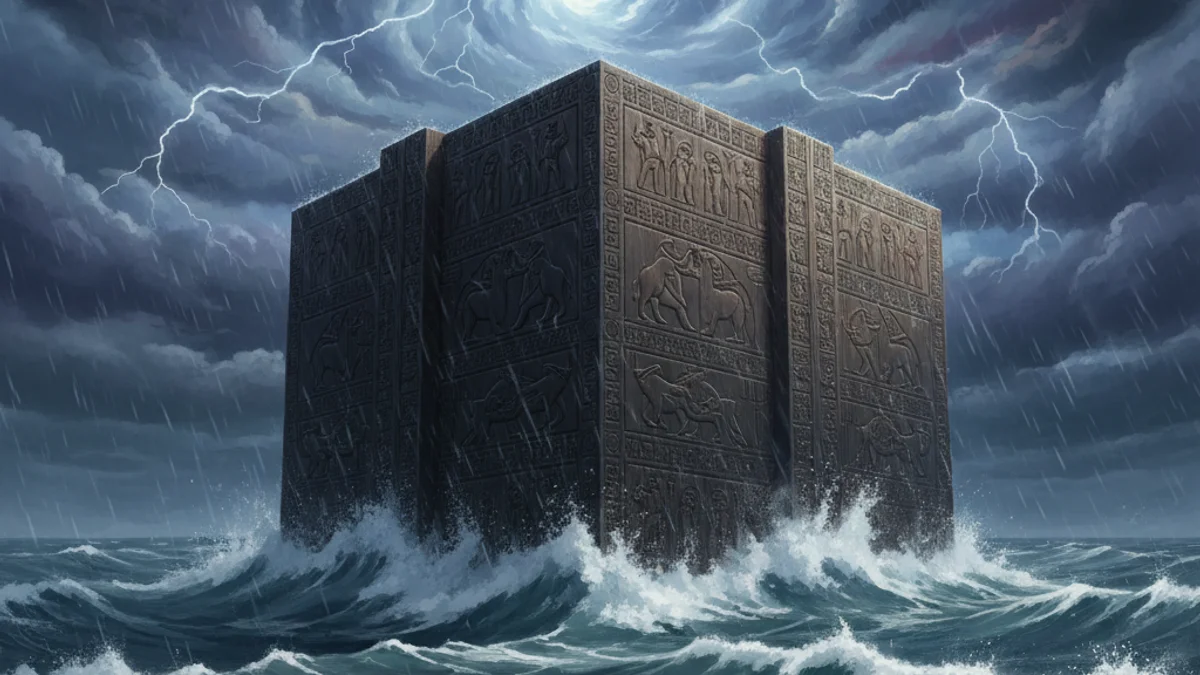
In the ancient city of Shuruppak, the gods grew weary of the clamor of humanity. Enlil, the king of the gods, decreed that a great flood would wipe out all life to restore silence. However, the wise god Enki, bound by an oath to protect mankind, whispered the secret to the reed wall of Utnapishtim’s house. He instructed Utnapishtim to tear down his house and build a massive, cubical boat, sealing it with bitumen and filling it with his family, craftsmen, and the seeds of all living creatures. For six days and seven nights, the storm raged, so fierce that even the gods retreated in terror to the highest heavens. When the sun finally broke through, the world had turned to clay. Utnapishtim released a dove, a swallow, and finally a raven, which did not return, signaling that land was near. Upon sacrificing to the gods on Mount Nimush, Enlil was initially enraged by the survival of a human, but Enki’s wisdom prevailed. To honor his resilience, the gods granted Utnapishtim and his wife the gift of immortality, placing them at the mouth of the rivers to live forever.
The Moral
While divine forces may be unpredictable, human foresight, obedience to wisdom, and the preservation of life can overcome even the greatest catastrophes.
“I watched the appearance of the weather and the weather was terrible to behold.”
Fun Fact
Utnapishtim's story is recorded on the eleventh tablet of the Epic of Gilgamesh, which is one of the oldest known pieces of literature in human history.
Frequently Asked Questions
What is the moral of Utnapishtim's Flood?
The moral emphasizes that wisdom and preparedness can preserve life even when faced with overwhelming, inevitable forces. It also highlights that immortality is a unique divine gift, contrasting with the common human fate of mortality.
How does Utnapishtim's story compare to Noah's Ark?
Both stories feature a divinely warned hero who builds a boat to save his family and animals from a global flood. However, Utnapishtim's ark is cubical and he is granted immortality, whereas Noah's story focuses on a covenant with a single deity.
Why did the gods decide to flood the earth?
In the Mesopotamian myth, the gods, led by Enlil, found the noise of human civilization too loud and disruptive to their sleep. They chose the flood as a way to silence the world and reduce the human population.
How did Utnapishtim survive the flood?
He survived because the god Enki warned him indirectly by speaking to the wall of his reed hut. This allowed Utnapishtim to build a massive, seven-decked vessel reinforced with pitch and bitumen to withstand the storm.
What happens to Utnapishtim after the flood?
After the flood subsides and he offers a sacrifice, the god Enlil blesses him. Utnapishtim and his wife are transformed into immortals and sent to live eternally at the 'distance' at the mouth of the rivers.
Who told the story of Utnapishtim to Gilgamesh?
Utnapishtim himself tells the story to King Gilgamesh. Gilgamesh seeks him out in the Epic of Gilgamesh to learn the secret of eternal life after the death of his friend Enkidu.
Discussion (0)
Share your thoughts on this story
No comments yet. Be the first to share your thoughts!