
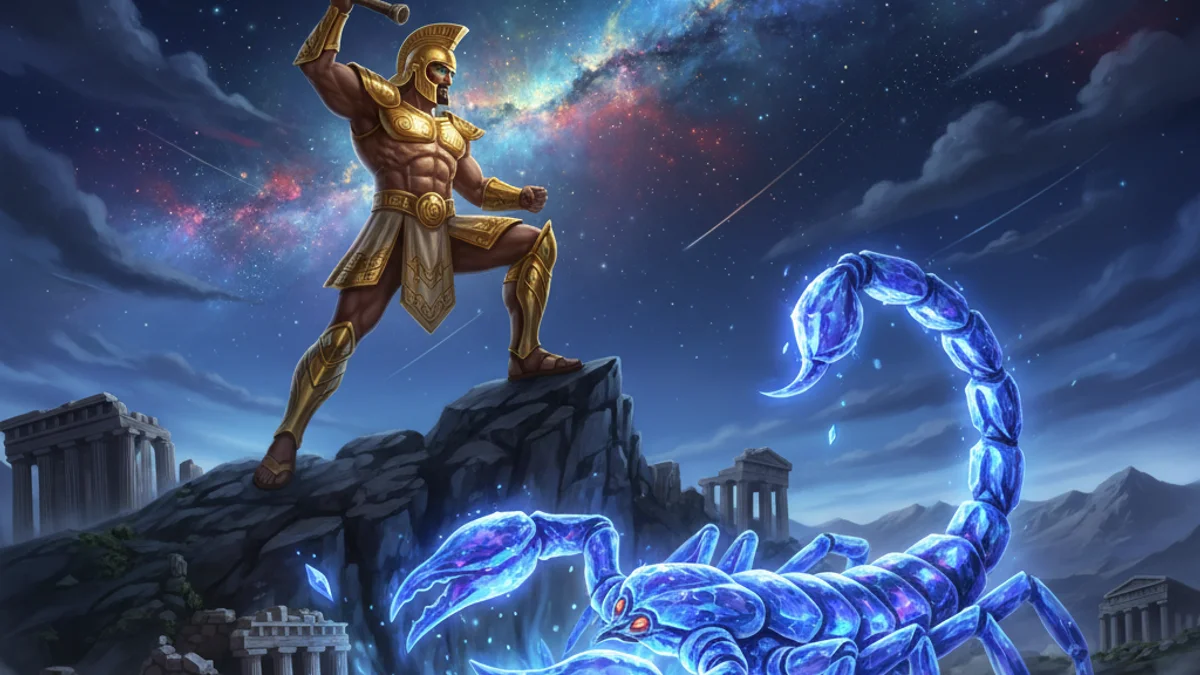
Orion was a giant of a man and a hunter of unparalleled skill, but his heart was filled with a dangerous pride. One day, he boasted to the goddess Artemis and her mother, Leto, that he could slay every wild beast on the face of the Earth. Gaia, the Earth Mother, was horrified by this arrogance and feared for her creatures. To humble the hunter, she summoned a small but deadly scorpion from a crack in the ground. Despite his massive strength and celestial weapons, Orion could not defend himself against the tiny creature's venomous sting. After his death, Zeus placed both the hunter and the scorpion among the stars as constellations. However, to ensure they would never fight again, he placed them at opposite ends of the heavens. To this day, as the constellation Scorpius rises in the east, Orion retreats and sets in the west, eternally fleeing the tiny foe that brought him low.
Arrogance and hubris lead to downfall, proving that even the strongest can be defeated by the smallest of creatures.
Questions about this story
Why do Orion and Scorpius never appear in the sky together?
In Greek mythology, they are placed on opposite sides of the celestial sphere to prevent them from continuing their battle. When one rises, the other sets, creating an eternal chase.
Who sent the scorpion to kill Orion?
The Earth goddess Gaia sent the scorpion to punish Orion for his boastful threat to kill every animal on Earth. She sought to protect the natural world from his arrogance.
What does Orion represent in Greek mythology?
Orion represents the archetype of the great hunter, but his story also serves as a cautionary tale about the dangers of hubris and pride against the gods.
Is Orion a real constellation?
Yes, Orion is one of the most recognizable constellations in the night sky, visible throughout the world, particularly during the winter months.
Advertisement
Good night.
