Story Summary
Explore the heart-wrenching Japanese folktale The Crane Wife. A poor man saves a bird, gains a wife, but loses everything to greed and a broken promise.
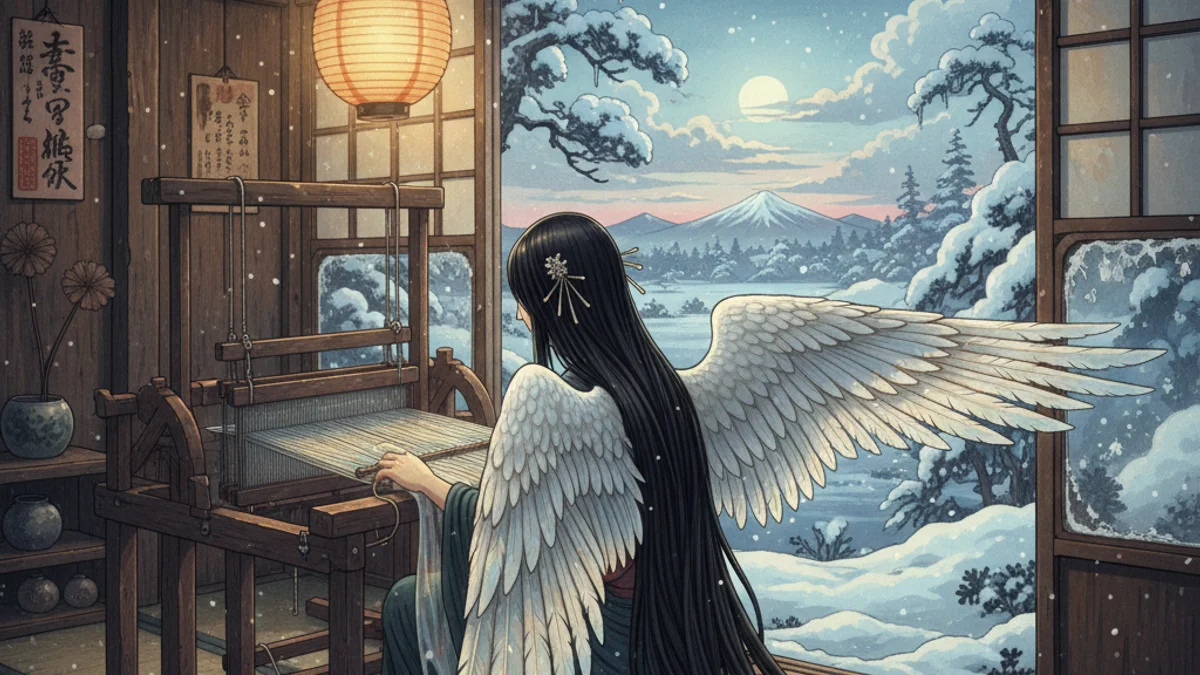
Once, a poor man named Karoku rescued a crane from a hunter's trap, gently pulling the arrow from its wing. Days later, a beautiful woman appeared at his door, and the two fell in love and married. To help with their poverty, she offered to weave a magnificent silk cloth on one condition: Karoku must never look inside the weaving room while she worked. She produced fabric so exquisite it sold for a small fortune. Driven by greed and pressured by others to produce more, Karoku finally succumbed to curiosity and peeked through the door. Instead of his wife, he saw a crane plucking its own white feathers to weave the cloth. Having broken the sacred promise and revealed her secret, the crane wife transformed back into her bird form and flew away into the winter sky, leaving Karoku alone with nothing but his regret.
The Moral
Trust is the foundation of love, and breaking a promise out of greed or curiosity can lead to the permanent loss of what we value most.
“You must promise me one thing: do not look in upon me while I am weaving.”
Fun Fact
This story belongs to a genre of Japanese folklore called 'Irui Konin Tan,' which translates to 'stories of marriages between different species.'
Frequently Asked Questions
What is the moral of The Crane Wife?
The moral centers on the sanctity of promises and the destructive nature of greed. It teaches that once trust is broken and a secret boundary is violated, the relationship may be lost forever.
Why did the crane wife have to leave?
She had to leave because Karoku broke his solemn promise not to look at her while she was weaving. In Japanese folklore, once a supernatural being's true identity is revealed to a mortal, they can no longer stay in the human world.
What was the crane weaving into the cloth?
The crane was plucking her own feathers and weaving them into the fabric to make it exceptionally beautiful and valuable. This act represents the ultimate sacrifice of herself for her husband's well-being.
What is the Japanese name for this story?
The story is commonly known in Japan as 'Tsuru no Ongaeshi,' which translates to 'The Crane's Return of a Favor.' It is one of the most famous examples of the gratitude motif in folklore.
What caused Karoku to break his promise?
Karoku was driven by a combination of curiosity and greed. As the money from the silk grew, he was pressured by a desire for more wealth and forgot the gratitude he owed his wife for her labor.
Is The Crane Wife a true story?
No, it is a traditional Japanese folktale. It serves as a metaphorical myth meant to convey cultural values regarding honor, gratitude, and the consequences of betraying trust.
Discussion (0)
Share your thoughts on this story
No comments yet. Be the first to share your thoughts!