Story Summary
Experience the epic Death of Bhishma from the Mahabharata. Discover how the grand patriarch fell on a bed of arrows to fulfill his destiny and protect dharma.
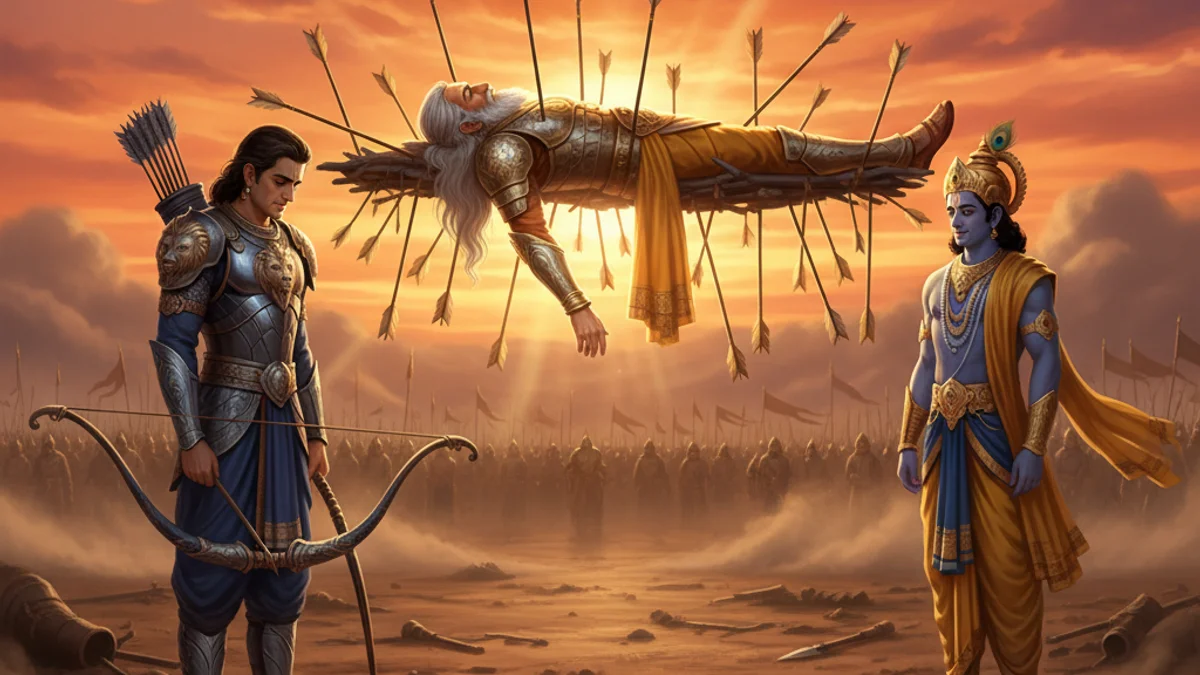
On the tenth day of the Great Kurukshetra War, the fall of the invincible Pitamaha Bhishma was imminent. Bound by his oath to the throne of Hastinapur, Bhishma fought for the Kauravas, though his heart lay with the Pandavas. Recognizing that Bhishma would never strike a woman or one born as a woman, Arjuna positioned Shikhandi—reborn from Amba to seek vengeance—at the front of his chariot. As Shikhandi unleashed arrows, Bhishma lowered his bow, refusing to fight back. Seizing this moment of vulnerability, Arjuna pierced Bhishma with countless arrows. The patriarch fell, but his body did not touch the ground; it was held aloft by the sheer density of the arrows embedded in him. Having the boon of 'Iccha Mrityu' (death by choice), Bhishma chose not to die immediately. He waited upon his 'Sarasajya' (bed of arrows) for fifty-eight days until the sun entered the auspicious northern solstice, delivering final discourses on kingship and dharma before finally surrendering his soul.
The Moral
True righteousness requires the sacrifice of personal ego and the recognition that even the most honorable vows must yield to the greater good of Dharma.
“Death is but a transition for one who has lived according to his Dharma.”
Fun Fact
Bhishma's original name was Devavrata; he earned the name Bhishma, meaning 'The Terrible,' after taking his formidable vow of lifelong celibacy and renouncing his claim to the throne.
Frequently Asked Questions
Who was responsible for Bhishma's death?
Arjuna was the one who fired the fatal arrows, but he could only do so by using Shikhandi as a shield. Shikhandi's presence forced Bhishma to lower his weapons due to his vow never to fight a woman.
What is the bed of arrows or Sarasajya?
When Bhishma fell, his body was so filled with arrows that they formed a support, keeping him suspended above the ground. This iconic image is known as the Sarasajya, symbolizing his warrior status and his final penance.
Why did Bhishma fight for the Kauravas?
Bhishma was bound by a lifelong vow of loyalty to the throne of Hastinapur. Despite knowing the Kauravas were in the wrong, his rigid sense of duty (dharma) to his promise forced him to lead their army.
What was Bhishma's boon of Iccha Mrityu?
His father, King Shantanu, granted him the boon of 'Iccha Mrityu,' which meant death would only come to him when he chose it. This allowed him to control the timing of his departure from the physical world.
Why did Bhishma wait to die?
Bhishma waited for the sun to move into the northern hemisphere (Uttarayana), an auspicious time for a soul to leave the body. During this period, he shared profound wisdom on ethics and governance with the Pandavas.
How did Bhishma finally die in the Mahabharata?
Bhishma died by his own will after the war ended and the Pandavas visited him. After imparting his final teachings on the Shanti Parva, he used his yogic power to release his soul, having fulfilled his earthly duties.
Discussion (0)
Share your thoughts on this story
No comments yet. Be the first to share your thoughts!