Story Summary
Witness the tragic fall of the sun-born warrior in The Death of Karna. Explore the final duel between Arjuna and Karna shaped by curses, fate, and cosmic duty.
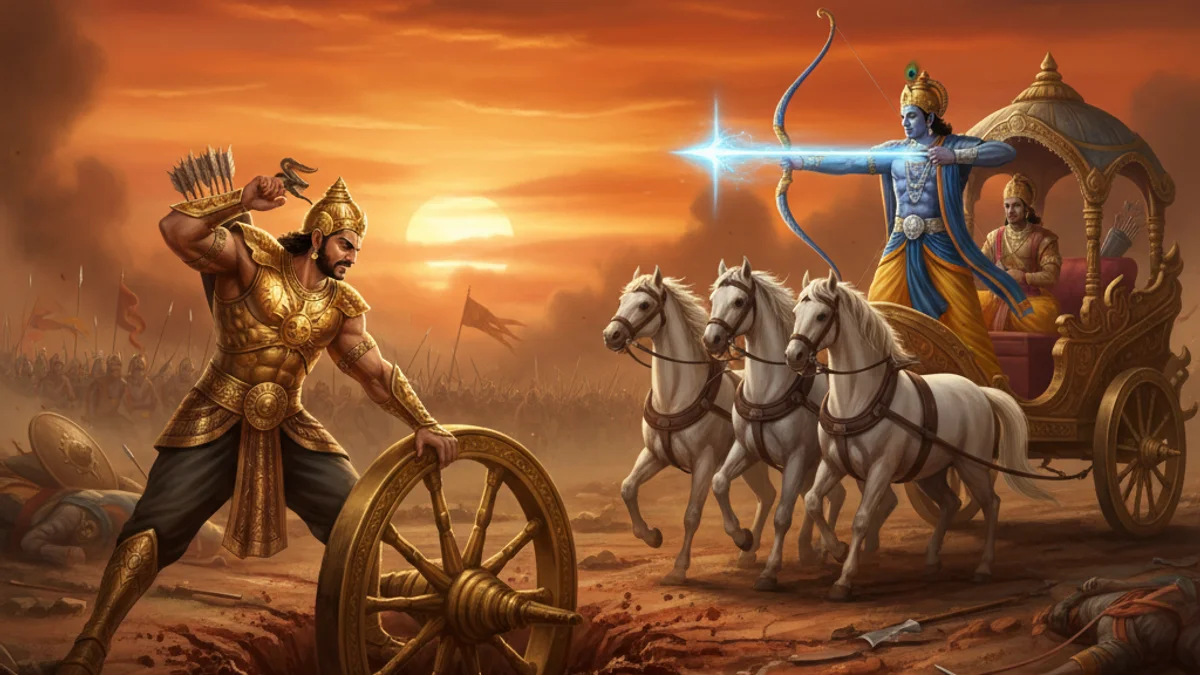
On the seventeenth day of the Kurukshetra War, the ultimate duel between Karna and Arjuna reached its peak. As the two master archers exchanged celestial weapons, the weight of ancient curses began to settle upon Karna. Suddenly, the earth softened, and the wheel of Karna’s chariot sank deep into the mud. Recalling the curse of a Brahmin, Karna found his vehicle immobilized. He descended to the ground to lift the wheel, attempting to invoke the Brahmastra to hold Arjuna at bay. However, Parashurama’s curse took hold; at the moment of his greatest need, Karna’s memory failed, and he forgot the sacred incantations. Seizing this moment, Lord Krishna urged a hesitant Arjuna to strike, reminding him of Karna’s role in the unrighteous slaughter of Abhimanyu. Arjuna loosed the Anjalika weapon, and the celestial arrow severed the head of the sun-born hero. Karna fell, his life a testament to a warrior who chose loyalty to a friend over the path of righteousness.
The Moral
Individual greatness and charity cannot protect a person who chooses to align themselves with unrighteousness.
“Dharma protects those who protect it, but even the sun must set when fate demands.”
Fun Fact
Karna is often called 'Danaveera' because of his legendary generosity; he once cut off his own divine armor and gave it away to Indra, even though he knew it would make him mortal.
Frequently Asked Questions
What is the moral of The Death of Karna?
The moral is that aligning oneself with unrighteousness (Adharma) leads to an inevitable downfall, regardless of one's personal virtues or skills. It teaches that duty to the truth is higher than personal loyalty to a friend who is wrong.
Why couldn't Karna fight back at the end?
Karna was paralyzed by two major curses: one that made his chariot wheel sink into the ground, and another from his teacher Parashurama that caused him to forget his most powerful mantras when he needed them most.
Was Arjuna's killing of Karna considered fair?
In the strict code of Kshatriya warfare, killing an unarmed warrior is forbidden. However, Krishna argued it was justified because Karna had previously broken those same codes during the killing of Arjuna's son, Abhimanyu.
Who were Karna's biological parents?
Karna was the secret son of Kunti, the mother of the Pandavas, and Surya, the Sun God. He was born with divine armor and earrings that made him nearly invincible.
What was the significance of the chariot wheel?
The sinking wheel represented the Earth itself turning against Karna due to a Brahmin's curse. It served as the physical obstacle that prevented him from continuing the duel on equal footing with Arjuna.
How did Krishna influence the outcome of the battle?
Krishna acted as Arjuna's strategist and charioteer, providing the moral and tactical justification for striking Karna while he was vulnerable, ensuring that the side of Dharma (righteousness) would prevail.
Discussion (0)
Share your thoughts on this story
No comments yet. Be the first to share your thoughts!