Story Summary
Explore the legend of Shiva and the Poison, where Lord Shiva drinks the Halahala to save the universe during the churning of the ocean by gods and demons.
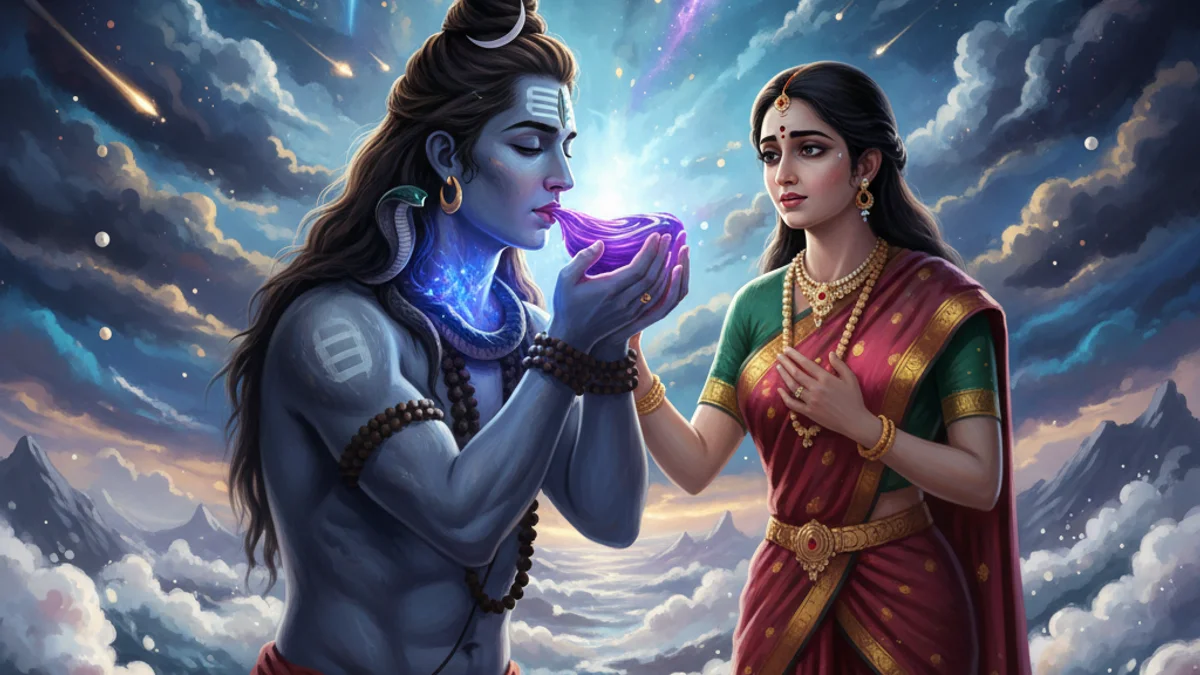
In a time of ancient struggle, the Devas (gods) and Asuras (demons) joined forces to churn the cosmic Ocean of Milk to obtain Amrita, the nectar of immortality. Using Mount Mandara as a churning rod and the serpent Vasuki as a rope, they toiled for ages. However, before the nectar could surface, a terrifying, dark sludge called Halahala—the most lethal poison in existence—erupted from the depths. Its fumes began to choke the universe, threatening to incinerate all life. In desperation, the beings turned to Lord Shiva, the Destroyer. Compassionate and fearless, Shiva took the poison into his hands and swallowed it. Seeing this, his consort Parvati gripped his throat to stop the venom from reaching his stomach, where it might destroy the world within him. The poison stayed in his throat, turning it a deep, vibrant blue. Thus, Shiva saved the cosmos and earned the name Neelkanth, the Blue-Throated One.
The Moral
The highest form of divinity is seen in the willingness to sacrifice oneself and absorb the world's suffering for the protection of others.
“I shall drink the world's pain so that it may live.”
Fun Fact
The story of Neelkanth is often celebrated during the festival of Maha Shivaratri, honoring Shiva's role as the protector of the universe.
Frequently Asked Questions
What is the moral of Shiva and the Poison?
The story teaches that true greatness lies in self-sacrifice and the ability to transform negativity for the greater good. Shiva’s act represents the protection of the innocent from inevitable destruction.
Why is Shiva called Neelkanth?
Shiva is called Neelkanth, meaning 'Blue-Throated One,' because the Halahala poison stayed in his throat. Parvati’s touch prevented it from entering his body, leaving a permanent blue mark on his neck.
What was the Samudra Manthan?
Samudra Manthan is the Churning of the Ocean of Milk by the gods and demons. They sought various treasures and the nectar of immortality, but the process also released the deadly Halahala poison.
What does the Halahala poison represent?
Symbolically, the poison represents the obstacles and negative outcomes that often arise during the pursuit of a great goal. It reminds us that progress requires dealing with byproduct challenges.
Who helped Shiva stop the poison?
Goddess Parvati played a crucial role by clutching Shiva's throat as he swallowed the poison. Her intervention ensured that the poison neither harmed Shiva nor the living beings residing within his stomach.
What happened to the nectar after the poison?
After Shiva consumed the poison and stabilized the universe, the churning continued until the physician-god Dhanvantari emerged with the pot of Amrita. The gods eventually consumed it to become immortal.
Discussion (0)
Share your thoughts on this story
No comments yet. Be the first to share your thoughts!