Story Summary
Discover the legendary Vasishtha and Vishwamitra's Feud, a tale of a king's quest for spiritual supremacy and the ultimate triumph of patience over pride.
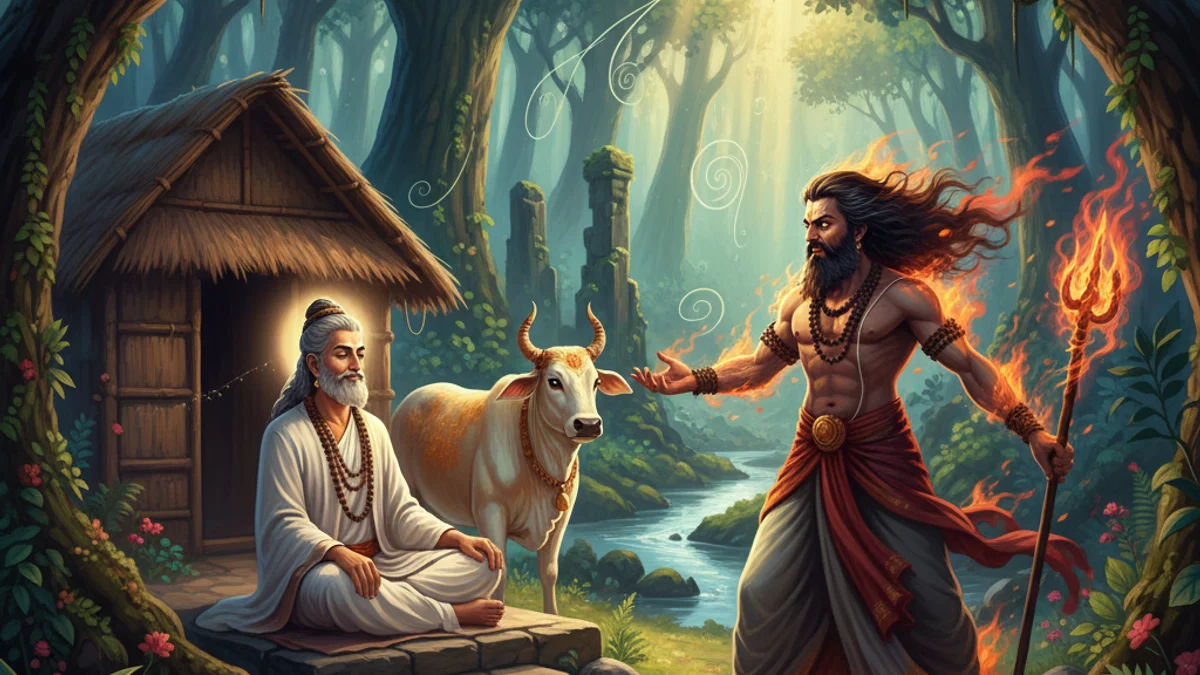
King Vishwamitra once visited the hermitage of Sage Vasishtha, who possessed the divine, wish-fulfilling cow, Nandini. After Nandini effortlessly provided a feast for the King's entire army, Vishwamitra demanded the cow for himself. When Vasishtha refused, the King attempted to take her by force, only to be defeated by the spiritual warriors Nandini summoned from her own body. Humiliated, Vishwamitra realized that spiritual power surpassed physical might. He abdicated his throne and performed thousands of years of grueling penance to become a Brahmarishi. Throughout his journey, his ego and lingering resentment toward Vasishtha led to many conflicts, including the subversion of cosmic laws. It was only when Vishwamitra finally let go of his pride and anger that Vasishtha warmly acknowledged him as a true Brahmarishi, ending their centuries-long rivalry with mutual respect.
The Moral
True power is found through self-mastery and the transcendence of ego, rather than through external dominance or anger.
“True power lies not in the conquest of kingdoms, but in the conquest of one's own ego.”
Fun Fact
Vishwamitra is traditionally credited as the seer of the Gayatri Mantra, one of the most sacred and widely chanted prayers in Hinduism.
Frequently Asked Questions
What is the moral of Vasishtha and Vishwamitra's Feud?
The story teaches that spiritual enlightenment and inner peace are superior to worldly power and ego. It emphasizes that true greatness is achieved only when one conquers anger and pride.
Who was Nandini in the story of Vasishtha and Vishwamitra?
Nandini was the divine, wish-fulfilling cow belonging to Sage Vasishtha. She was the daughter of Kamadhenu and possessed the power to manifest anything her owner required for sacred rituals.
Why did Vishwamitra want to become a Brahmarishi?
Initially, he sought the title out of jealousy to prove he was equal to Vasishtha. He wanted to attain the highest spiritual authority to match the power that had defeated his royal armies.
How did Vasishtha react to Vishwamitra's provocations?
Vasishtha remained remarkably patient and calm, embodying the quality of 'Kshama' or forgiveness. He only used his spiritual power defensively and refused to acknowledge Vishwamitra's status until the King had truly shed his ego.
Did Vishwamitra and Vasishtha ever reconcile?
Yes, they reconciled after Vishwamitra completed his final penance and abandoned his hatred. Vasishtha's recognition of him as a Brahmarishi marked the end of their long-standing enmity.
What is the significance of the title Brahmarishi?
A Brahmarishi is the highest class of sage who has realized the ultimate truth (Brahman). In the story, it represents the pinnacle of spiritual evolution that cannot be reached through effort alone, but requires total ego-dissolution.
Discussion (0)
Share your thoughts on this story
No comments yet. Be the first to share your thoughts!