Story Summary
Witness the terrifying legend of The Wild Hunt as Odin leads a spectral army across the winter sky in this chilling tale from Norse mythology and folklore.
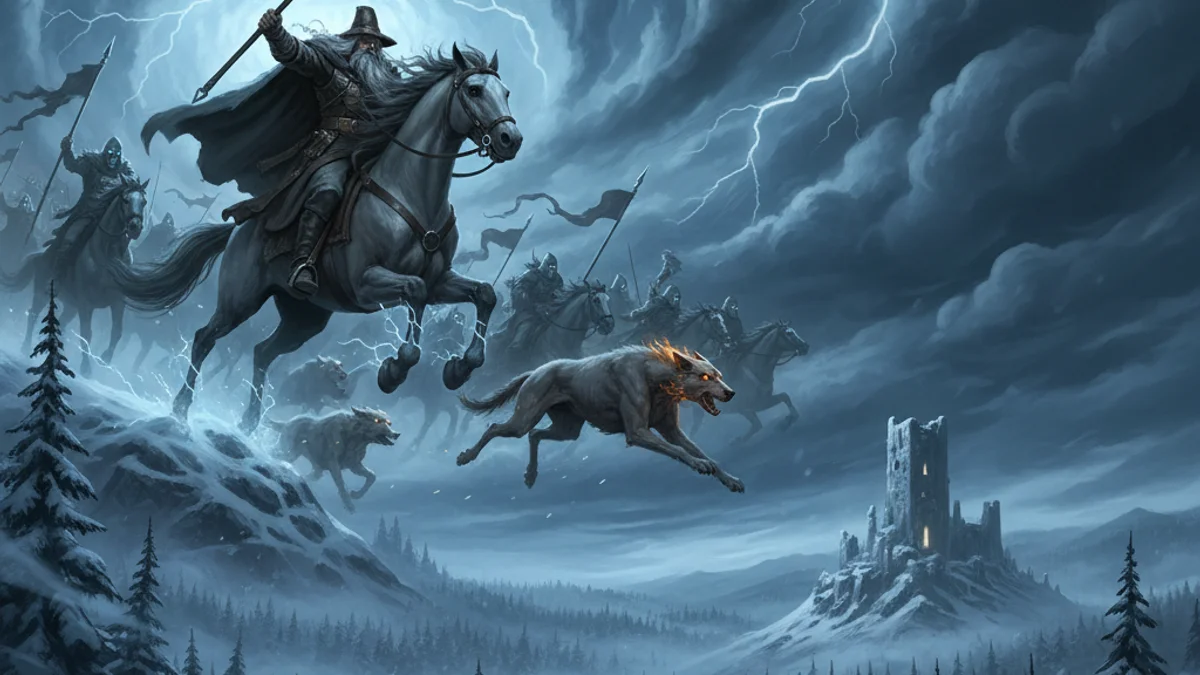
When the winter winds howl across the Scandinavian peaks and the nights grow long, the gates of Valhalla and Hel open wide. This is the time of the Wild Hunt, known as the Oskoreia. At the head of this spectral procession rides Odin, mounted upon his eight-legged steed Sleipnir, his great blue cloak billowing like storm clouds. Behind him follows a terrifying host of ghostly warriors, baying black hounds with eyes of fire, and the spirits of the restless dead. They thunder across the sky, their passage marked by the clatter of hooves and the discordant blast of hunting horns. To the mortals below, the hunt is a terrifying omen. Wise travelers hide their faces in the dirt, for to witness the procession is to risk being snatched up by the phantom riders or cursed with misfortune. The Hunt sweeps away the stagnant spirits of the old year, reminding all that the veil between the living and the dead is thinnest during the darkest days of winter.
The Moral
The story serves as a reminder to respect the boundaries between the mortal and divine realms and to prepare for the inevitable cycles of change and destruction.
“When the wind howls at the door, do not look out, for the King of the Dead rides tonight.”
Fun Fact
The Wild Hunt is widely believed to be one of the primary historical influences on the modern legend of Santa Claus and his flying reindeer.
Frequently Asked Questions
What is the moral of The Wild Hunt?
The moral emphasizes the power of the divine and the thin veil between life and death. it teaches respect for the unknown forces of nature and the spirits that govern them.
Who leads the Wild Hunt in Norse mythology?
In Norse tradition, the leader is usually Odin (or Wotan), often depicted riding his eight-legged horse Sleipnir and accompanied by his wolves and ravens.
What happens if a person sees the Wild Hunt?
According to legend, witnessing the hunt could lead to being abducted to the underworld, being forced to join the ride, or suffering a sudden and mysterious death.
When does the Wild Hunt typically occur?
The hunt is most commonly associated with the Twelve Days of Christmas or Yule, during the darkest and coldest period of the winter solstice.
Are there different versions of the Wild Hunt?
Yes, variations exist across Europe, with leaders ranging from King Arthur and Charlemagne to female figures like Berchta or Holda in Germanic folklore.
What does the Wild Hunt symbolize?
It symbolizes the transition between seasons, the clearing of old spirits to make way for the new year, and the untamed, chaotic power of the wilderness.
Discussion (0)
Share your thoughts on this story
No comments yet. Be the first to share your thoughts!