Story Summary
In the Sufi tale Nasrudin and the Neighbor's Lamp, Mulla searches for a lost key in the light because it's easier to see, offering a witty lesson on human bias.
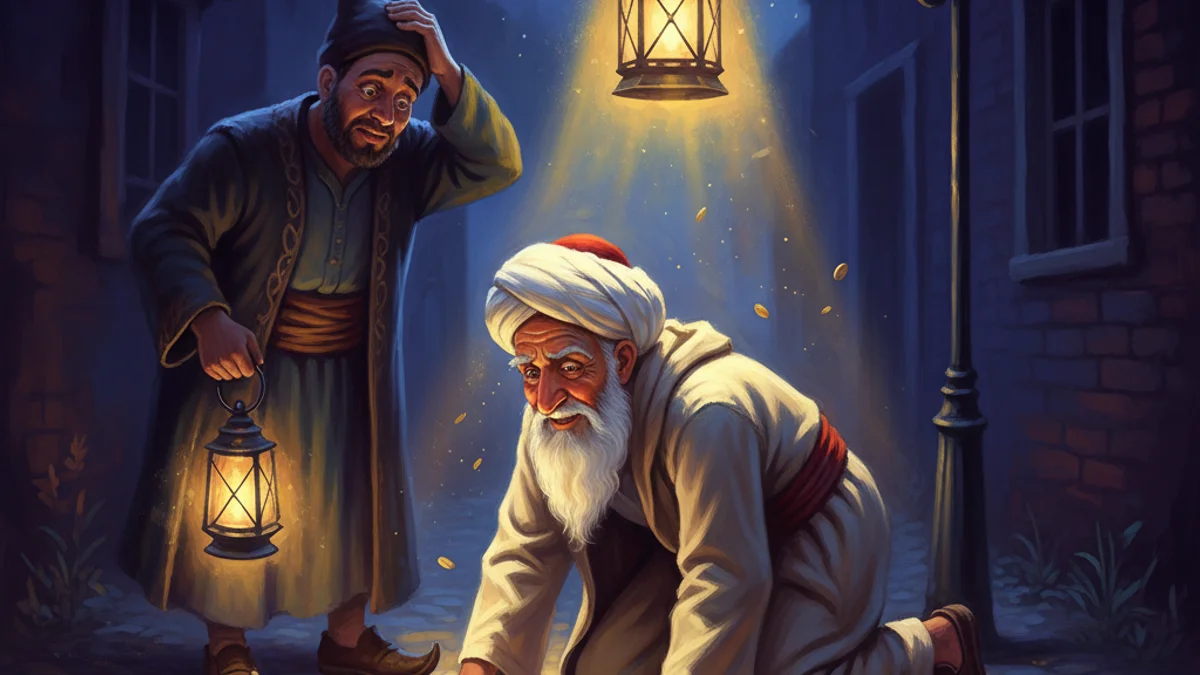
One evening, a neighbor found Mulla Nasrudin on his hands and knees, searching frantically for something on the ground beneath a bright street lamp. 'What have you lost, Mulla?' the neighbor asked. 'I have lost the key to my house,' Nasrudin replied. The neighbor joined the search, and for an hour, the two men combed the dust under the light. Finally, finding nothing, the neighbor asked, 'Are you certain you dropped it exactly here?' Nasrudin shook his head and pointed toward the pitch-black alleyway behind them. 'No, I dropped it over there, in the darkness.' Stunned, the neighbor asked, 'Then why on earth are we looking here?' Nasrudin looked at him as if he were the foolish one and said, 'Because there is much more light over here!'
The Moral
We often seek solutions in external, comfortable places where it is easy to look, rather than facing the internal darkness where the truth actually resides.
“Why look there when the light is so much better here?”
Fun Fact
This parable is so culturally significant that it inspired a formal scientific principle known as 'The Streetlight Effect,' which warns researchers against looking for data only where it is easy to find.
Frequently Asked Questions
What is the moral of Nasrudin and the Neighbor's Lamp?
The moral is that people often search for happiness or answers where they are easiest to find rather than where they actually are. It critiques the human tendency to favor convenience over truth.
What does the street lamp symbolize in this story?
The lamp symbolizes the superficial or intellectual 'light' of the ego and external world. It represents our comfort zones and the places where we feel safe, even if they hold no real answers.
Why is this story sometimes called 'The Lost Key'?
The story is known by several names, including 'The Lost Key,' because the key is the central object representing the solution to a problem or the entry point to one's inner self.
Is Mulla Nasrudin a real historical figure?
While many towns claim to be his birthplace, Nasrudin is largely considered a legendary character in Sufi folklore. He serves as a 'wise fool' who uses humor to deliver profound spiritual insights.
What is the 'Streetlight Effect' in psychology?
The 'Streetlight Effect' is a type of observational bias named after this very story. it describes the phenomenon where people only search for information where it is easiest to look.
How does this story relate to Sufism?
In Sufism, the story suggests that spiritual seekers often look for God or enlightenment in external rituals because they are visible, while the true path requires going into the 'dark' internal self.
Discussion (0)
Share your thoughts on this story
No comments yet. Be the first to share your thoughts!