
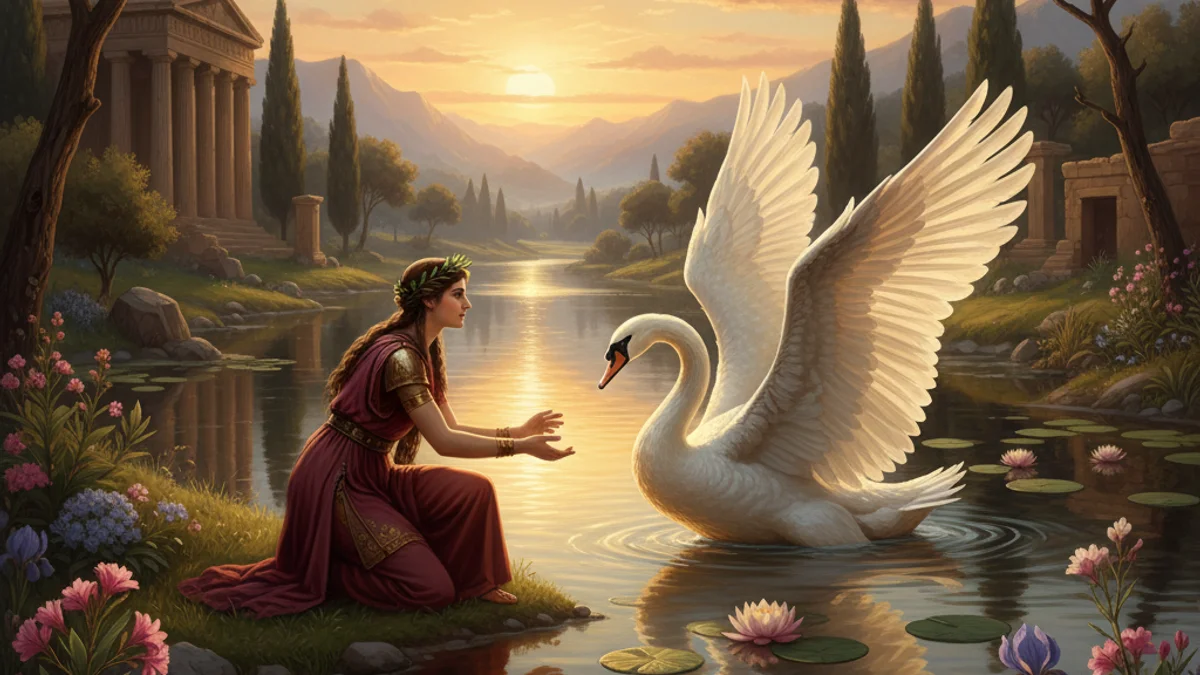
Leda, the beautiful Queen of Sparta and wife of King Tyndareus, was bathing alone in the river Eurotas when she caught the eye of Zeus. To bypass the watchful gaze of his wife Hera and approach the mortal queen, Zeus transformed himself into a magnificent, snow-white swan. He plummeted toward the river as if being hunted by an eagle, seeking sanctuary in Leda's gentle embrace. Charmed by the bird's grace and apparent distress, Leda comforted the swan, unaware of the divine power hidden beneath its feathers. This encounter resulted in Leda laying two eggs, from which hatched four children: Helen of Troy and Pollux, the divine offspring of Zeus, and Clytemnestra and Castor, the mortal children of Tyndareus. This single moment of divine artifice set in motion the epic events that would eventually lead to the fall of Troy.
Divine intervention often carries heavy consequences, showing that even the most beautiful encounters can reshape the fate of the world.
Questions about this story
What is the moral of Zeus and Leda?
The story illustrates that the actions of the powerful can have far-reaching, unintended consequences for humanity. It also emphasizes the inescapable nature of destiny when gods involve themselves in mortal lives.
Why did Zeus turn into a swan to meet Leda?
Zeus frequently used shapeshifting to hide his infidelities from his wife Hera and to approach mortals without overwhelming them with his true divine form. The swan allowed him to appear vulnerable and beautiful to Leda.
Who were the children of Zeus and Leda?
According to the myth, Leda gave birth to Helen of Troy and the hero Pollux as children of Zeus. Her other children, Castor and Clytemnestra, were considered the mortal offspring of her husband, King Tyndareus.
How does this story lead to the Trojan War?
The union produced Helen of Troy, whose legendary beauty became the primary cause of the Trojan War when she was taken from Sparta by Paris. Without Zeus’s encounter with Leda, the most famous war in mythology might never have happened.
Advertisement
Teach next

Good night.
