
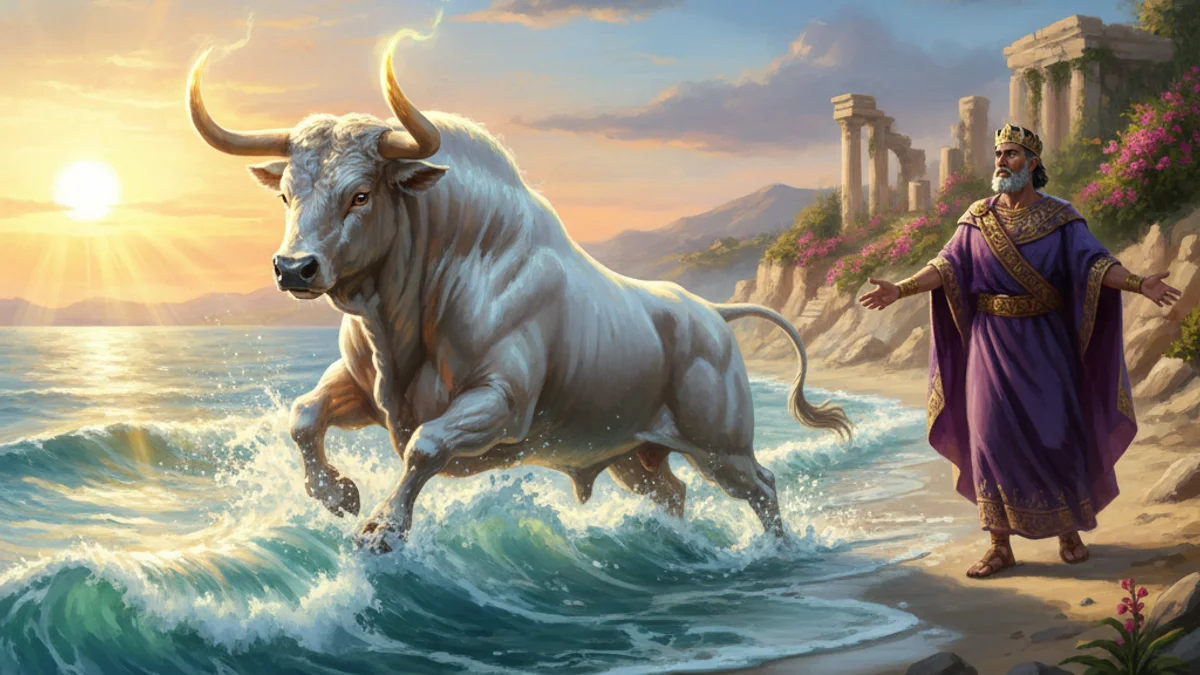
King Minos of Crete sought a sign of his divine right to rule, praying to Poseidon for a miracle. The god of the sea sent a majestic white bull rising from the foam, with the condition that it must be sacrificed in his honor. However, struck by the beast’s beauty and greed, Minos kept it and offered an inferior bull instead. Enraged by this hubris, Poseidon cursed Minos’s wife, Queen Pasiphae, with an unnatural passion for the bull. With the help of the inventor Daedalus, who crafted a hollow wooden cow for her to hide inside, she conceived a child with the beast. The result was the Minotaur—a monstrous creature with the body of a man and the head of a bull. Ashamed and horrified, Minos commissioned Daedalus to build the Labyrinth, a vast and inescapable maze, to hide the beast from the world, eventually demanding human sacrifices to satisfy its hunger.
Breaking a sacred promise to the gods leads to devastating consequences that cannot be hidden by walls.
Questions about this story
Why did Poseidon punish King Minos?
Poseidon punished King Minos because the king broke a sacred oath. Minos had promised to sacrifice the divine white bull sent by the god but kept it for his own herd instead.
How was the Minotaur born?
The Minotaur was born after Poseidon cursed Queen Pasiphae to fall in love with the Cretan Bull. She used a wooden cow built by Daedalus to approach the animal, resulting in the birth of the hybrid monster.
What does the Minotaur look like?
In Greek mythology, the Minotaur is depicted as having the muscular body of a man and the head and tail of a powerful bull. It represents the savage nature hidden within civilization.
Who built the Labyrinth?
The Labyrinth was designed and built by the master inventor Daedalus. King Minos ordered its construction to imprison the Minotaur and hide his family's shame from the public eye.
Advertisement
Teach next

Good night.
