
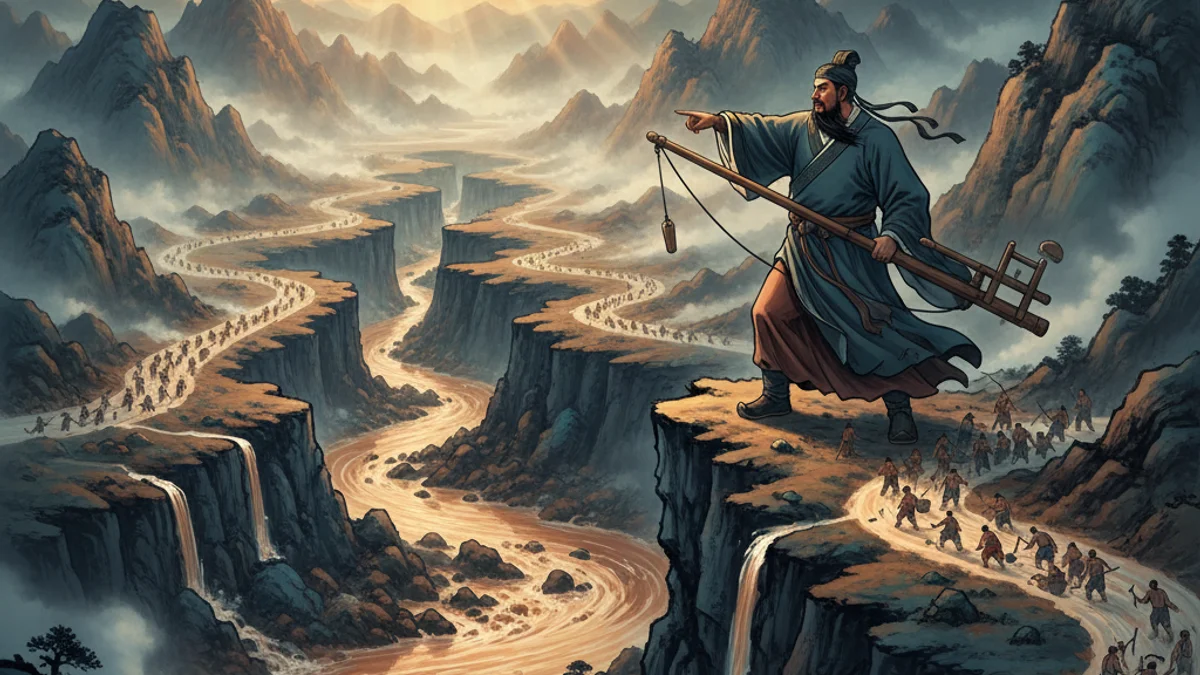
Long ago, a catastrophic flood ravaged ancient China, drowning fields and destroying homes for generations. Emperor Yao first tasked a man named Gun to stop the waters. Gun tried to block the floods with magical earth and massive dams, but the water grew stronger and eventually broke through, resulting in failure. When Yu, Gun's son, was chosen to succeed his father, he changed tactics. Instead of fighting the water's power with barriers, Yu spent thirteen years studying the terrain and digging canals to lead the water to the sea. He worked tirelessly alongside common laborers, becoming calloused and worn. Most famously, during his thirteen-year mission, he passed by his own home three times, hearing his wife and child inside, but he refused to enter, believing he could not rest while his people were still suffering. Through his engineering genius and unparalleled self-sacrifice, Yu successfully tamed the Yellow River, reclaimed the land for farming, and was eventually named Emperor, founding the Xia Dynasty.
Success is achieved through persistence, self-sacrifice for the greater good, and working in harmony with nature rather than trying to suppress it.
Questions about this story
What is the moral of Yu the Great Controls the Waters?
The moral emphasizes that leadership requires immense personal sacrifice and that solving complex problems requires patience and working with natural forces rather than against them.
Who was Yu the Great in Chinese mythology?
Yu the Great was a legendary ruler and hero credited with controlling the Great Flood and establishing the Xia Dynasty, the first dynasty in Chinese history.
How did Yu the Great stop the flood differently than his father?
While his father Gun tried to block the water using dams and barriers, Yu used a system of irrigation channels and canals to divert the water toward the ocean.
What does the phrase 'passing the door three times' mean?
It refers to Yu's extreme dedication; he passed his own home three times during his 13 years of work but never went inside because he was so focused on saving the people.
Advertisement


Good night.
