
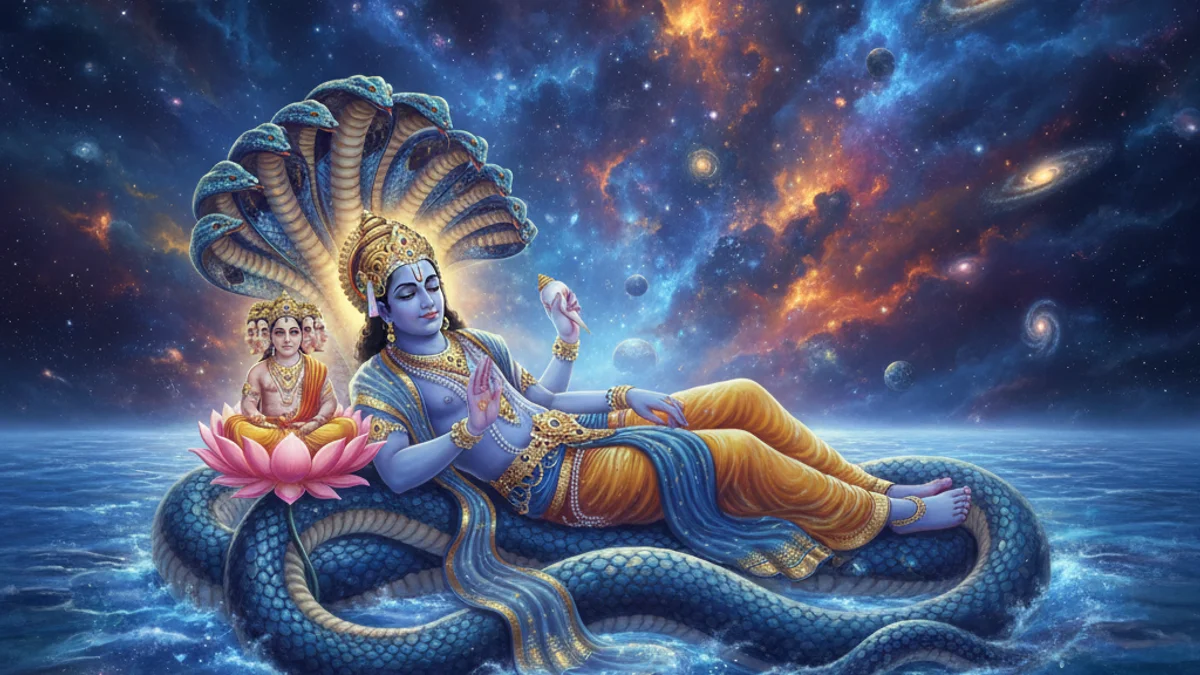
Before time began, there was only the vast, silent expanse of the Kshira Sagara, the Milky Ocean. Upon this infinite sea lay Lord Vishnu, reclining on the coiled body of the thousand-headed serpent, Shesha. In this state of Yoga Nidra—divine sleep—Vishnu exists in a trance that transcends space and time. As he exhales, countless universes bubble forth from the pores of his skin, expanding into the void. As he inhales, these universes dissolve back into his being. From his navel, a golden lotus blossomed, and upon its petals sat Brahma, the Creator. Under Vishnu's guidance, Brahma began the task of shaping the stars, the earth, and all living beings. To us, millions of years pass, but to Vishnu, it is merely the passing of a single dream. This cycle of creation, preservation, and dissolution continues eternally, reminding us that our reality is but a fragment of the divine consciousness.
Reality is a transient manifestation of the divine; understanding the cyclic nature of existence brings inner peace and detachment.
Advertisement
Questions about this story
What is the moral of Vishnu Dreams the Universe?
The story teaches that the universe is a temporary, cyclic manifestation of a higher divine reality. It encourages us to look beyond the material world to find the eternal truth.
What is Yoga Nidra in the context of Vishnu?
Yoga Nidra is the state of 'yogic sleep' or conscious dreaming where Vishnu maintains the universe. It represents a state of deep meditation where the supreme consciousness creates reality.
Who is the serpent Vishnu lies upon?
Vishnu reclines on Shesha (or Ananta), the king of all nagas. The serpent's many heads represent the infinite nature of time and the protection of the cosmic order.
How is Brahma related to Vishnu's dream?
Brahma is the secondary creator who emerges from a lotus growing from Vishnu's navel. While Vishnu provides the foundation, Brahma executes the physical design of the world.
Advertisement
