
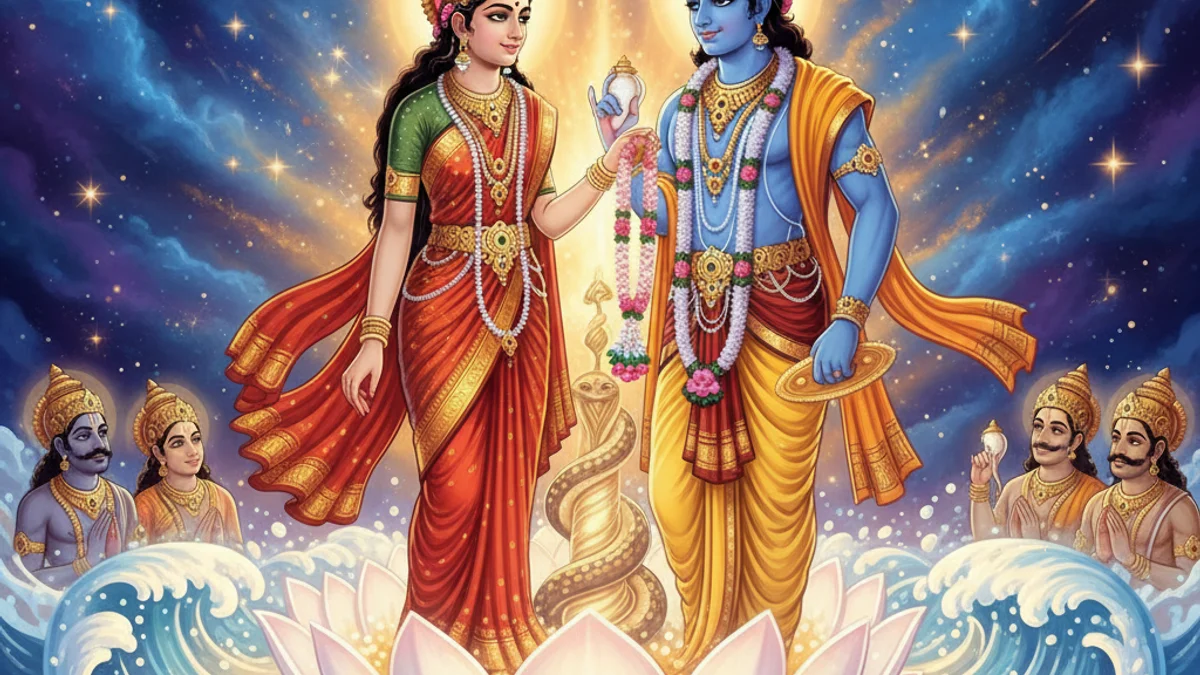
During the great Samudra Manthan, or the Churning of the Ocean of Milk, the Devas and Asuras sought the nectar of immortality. As the ocean yielded various treasures, a magnificent sight emerged: Goddess Lakshmi, the embodiment of beauty, wealth, and spiritual grace, rose from the frothing waves seated upon a blooming lotus. The gods, demons, and celestial beings were captivated by her radiance, each hoping she would choose them as her consort. Lakshmi looked upon them all, assessing their virtues. She saw those with great power but no humility, those with knowledge but no compassion, and those with penance but no love. Finally, her eyes met Lord Vishnu, the Preserver of the Universe. In him, she saw the perfect balance of strength, kindness, and eternal Dharma. She gracefully walked toward him and placed the Vaijayanti garland around his neck, choosing him as her eternal husband. This union signifies that wealth and prosperity (Lakshmi) naturally dwell where righteousness and cosmic order (Vishnu) are maintained.
True prosperity and wealth are most meaningful and enduring when they are guided by righteousness and the preservation of balance.
Questions about this story
How did Vishnu and Lakshmi first meet?
According to the Puranas, they met during the Samudra Manthan, or the Churning of the Ocean, where Lakshmi emerged as one of the divine treasures and chose Vishnu as her consort.
Why did Lakshmi choose Vishnu over the other gods?
Lakshmi chose Vishnu because he embodied the qualities of stability, compassion, and Dharma, showing that wealth belongs where there is a commitment to the welfare of the universe.
What does the union of Vishnu and Lakshmi represent?
Their union represents the inseparable bond between 'Purusha' (the cosmic spirit) and 'Prakriti' (material energy), or the necessity of wealth serving a righteous purpose.
What is the significance of the lotus in their story?
The lotus symbolizes purity, spiritual authority, and the ability to remain untainted by the world, even while rising from its depths.
Advertisement
Good night.
