
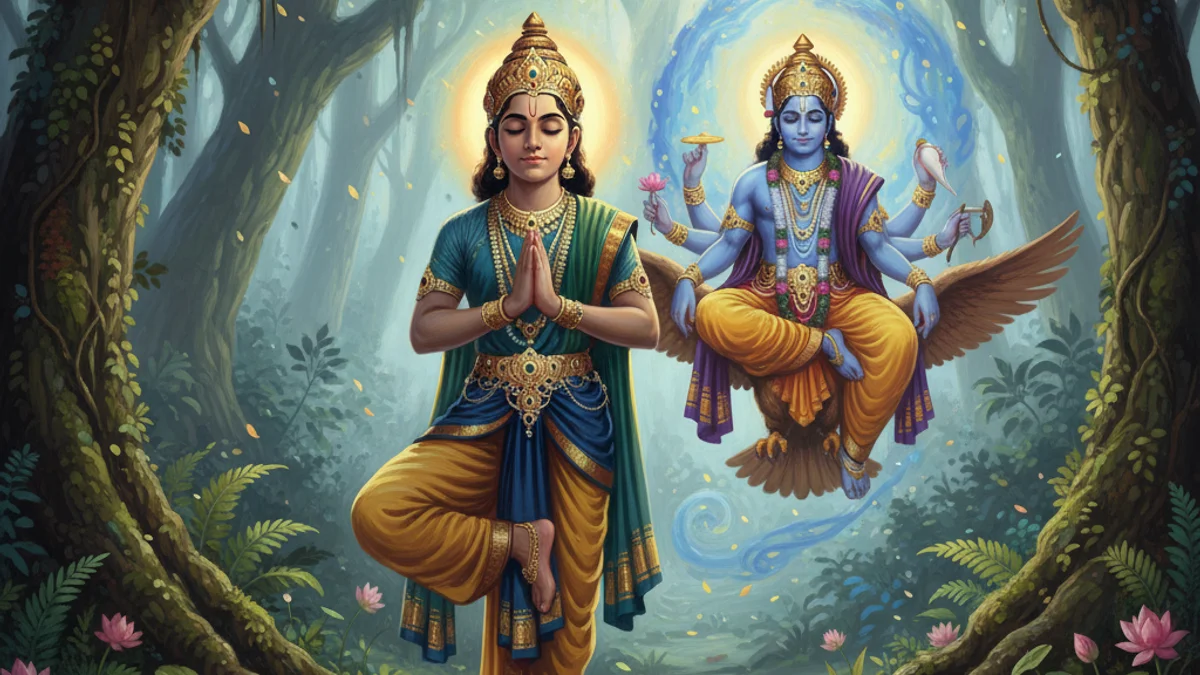
Prince Dhruva was the son of King Uttanapada and Queen Suniti. One day, while the King sat with his second wife Suruchi, young Dhruva tried to sit on his father's lap. Suruchi harshly rebuked him, claiming only her son deserved that honor and that Dhruva must pray to Lord Vishnu to be reborn from her womb to earn such a place. Heartbroken and insulted, Dhruva turned to his mother, Suniti, who advised him that only Lord Vishnu could grant him a status higher than any king. Determined, the five-year-old boy retreated to the Madhuvan forest. There, Sage Narada, impressed by his resolve, initiated him with the sacred mantra, 'Om Namo Bhagavate Vasudevaya.' Dhruva performed severe penance, eventually standing on one leg and subsisting only on air. His meditation was so powerful that it shook the heavens. Moved by his unwavering devotion, Lord Vishnu appeared before him. Though he initially sought a kingdom, the sight of the Divine purified Dhruva’s heart. Vishnu granted him a reign of thirty-six thousand years and eventually transformed him into the Dhruva Tara (the Pole Star), the most fixed and luminous point in the night sky.
Unwavering determination and sincere devotion to a higher purpose can overcome any earthly obstacle and lead to eternal greatness.
Questions about this story
What is the moral of Dhruva's Devotion?
The story teaches that with absolute focus, willpower, and faith, even a child can achieve the highest spiritual realization. It highlights that true devotion purifies worldly desires into spiritual wisdom.
Which mantra did Sage Narada give to Dhruva?
Sage Narada gave Dhruva the twelve-syllable mantra: 'Om Namo Bhagavate Vasudevaya.' This mantra is central to the practice of Bhakti Yoga and is dedicated to Lord Vishnu.
Why did Dhruva decide to go to the forest?
Dhruva went to the forest after being insulted by his stepmother, Suruchi, who told him he was unworthy of his father's lap. He sought a position so high that no one could ever displace him.
What is the significance of the Pole Star in this story?
The Pole Star is known as 'Dhruva Tara' in Sanskrit. Lord Vishnu granted Dhruva this eternal position in the sky to symbolize his fixed, unwavering devotion and steady character.
Advertisement
Good night.
