
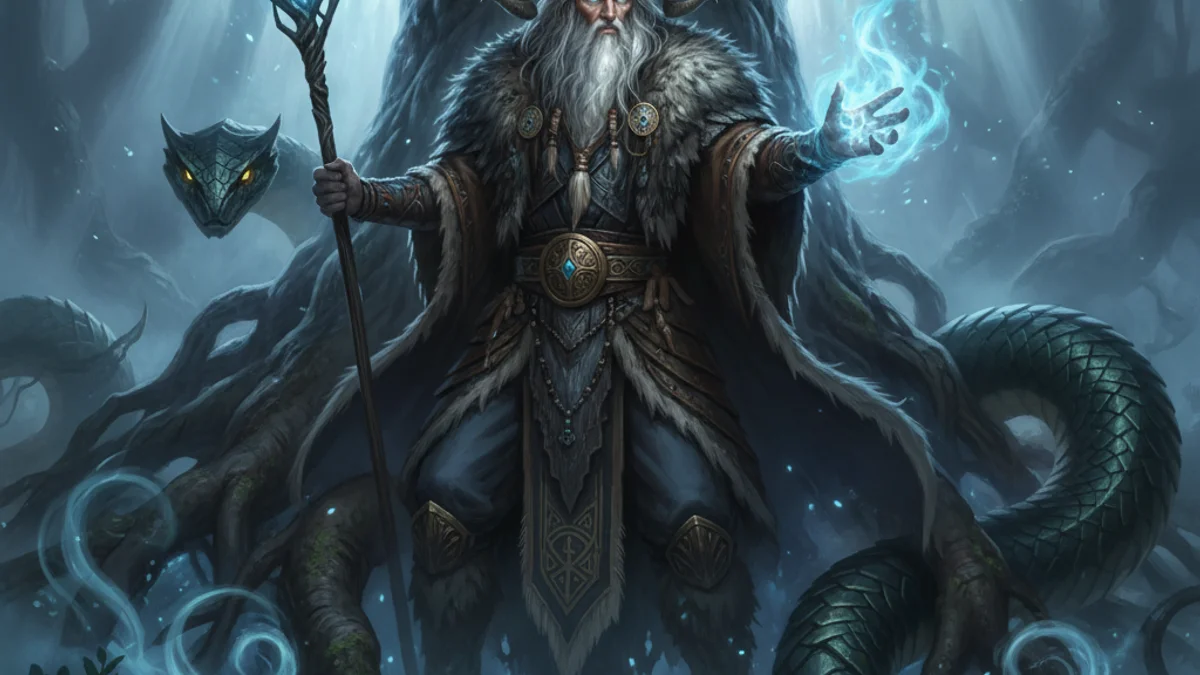
In the beginning, the world was divided by the Great World Tree. At its crown sat Perun, the thunder god, and at its roots dwelt Veles, the horned master of the underworld, magic, and wealth. Veles was the guardian of the souls of the deceased, guiding them to the verdant meadows of Nav. However, he was also a trickster. To challenge Perun’s authority, Veles would often ascend from the roots in the form of a great serpent to steal the sky god’s cattle, or even his wife. Perun would retaliate with bolts of lightning, chasing Veles across the world. Each time Veles was struck, he would retreat into the water or deep underground, only to return again. This eternal cycle of conflict was not a battle of good versus evil, but a necessary struggle that brought rain to the parched earth and maintained the balance between the celestial heights and the fertile depths.
True cosmic balance requires the interaction of opposing forces; both the order of the sky and the mysteries of the earth are vital for life.
Advertisement
Questions about this story
Who is Veles in Slavic mythology?
Veles is the major Slavic god of the underworld, earth, waters, magic, and livestock. He is the rival of the thunder god Perun and resides at the roots of the World Tree.
What is the relationship between Veles and Perun?
They are cosmic rivals whose eternal struggle represents the dualism of the world. Their conflict, often involving Veles stealing from Perun, is seen as the cause of changing seasons and storms.
What are the common symbols of Veles?
Veles is often associated with horns, bears, serpents, and the willow tree. He is frequently depicted as a bearded man with features of both a shepherd and a sorcerer.
Is Veles considered an evil god?
No, Veles is not evil in traditional Slavic belief. While he is a trickster and lord of the dead, he is essential for the cycle of life, wealth, and the protection of animals.
Advertisement
