
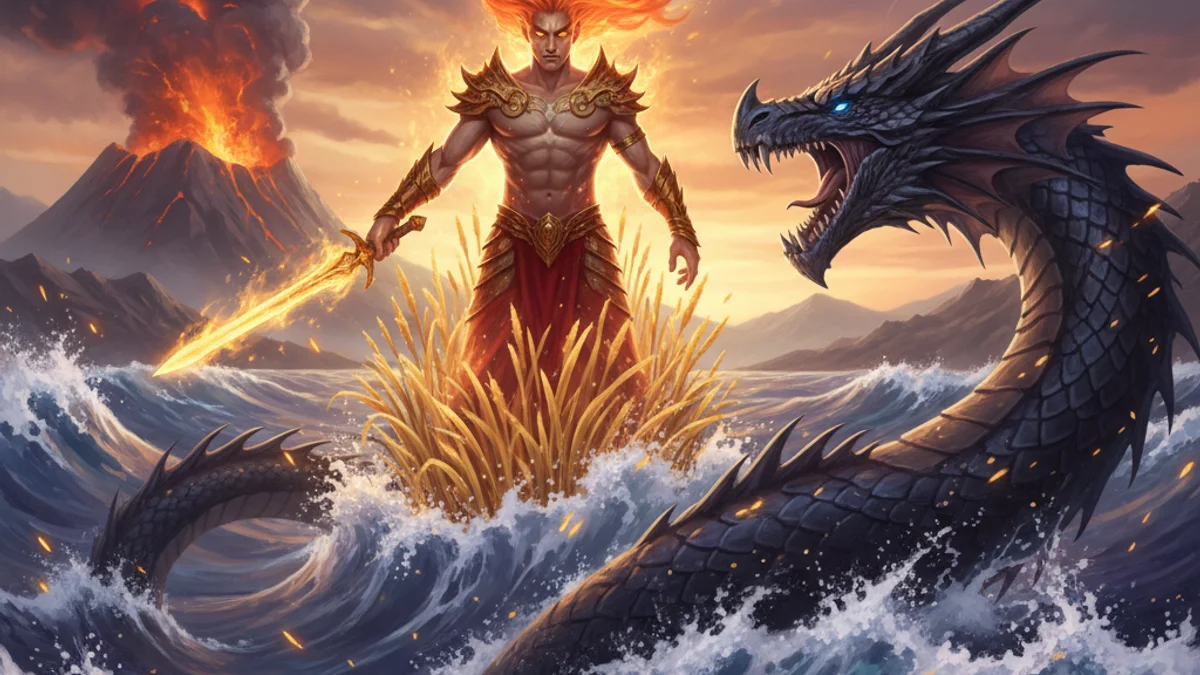
In the ancient days, when the cosmos was young, heaven and earth were in labor. The purple sea, too, felt the pangs of creation. From the depths of a scarlet reed in the churning waters, smoke and flame billowed forth. Through the fire ran a youth with hair of flame, a beard of flickering light, and eyes that shone like twin suns. This was Vahagn, the god of fire and courage. He did not wait for adulthood; he strode across the Armenian highlands to confront the Vishaps—monstrous water dragons that choked the springs and brought drought to the land. With a roar that shook the mountains, Vahagn wrestled the serpents, his fiery strength boiling the waters they inhabited. He slew the dragons one by one, restoring the flow of life to his people. So great was his power that once, while stealing straw from an enemy king to provide for his people during a harsh winter, he dropped golden stalks across the heavens, creating the Milky Way. Vahagn remains the eternal symbol of Armenian strength, the light that devours the darkness of the abyss.
True heroism lies in using one's inner fire and strength to protect life and overcome the chaos that threatens the natural world.
Questions about this story
What is the moral of Vahagn the Dragon Slayer?
The story teaches that courage and divine strength are necessary to conquer the monstrous forces of chaos. It emphasizes the hero's role as a protector of the people and the provider of essential resources.
Who is Vahagn in Armenian mythology?
Vahagn is the ancient Armenian god of fire, war, and victory. He is often compared to the Greek hero Hercules or the Vedic god Indra due to his dragon-slaying feats and immense physical power.
How was Vahagn born?
According to the ancient poem, Vahagn was born from a reed in the purple sea amidst smoke and flame. He emerged as a youth with hair of fire and eyes that glowed like suns.
What are Vishaps in Armenian legends?
Vishaps are mythical water-dragons or serpents that were believed to control the weather and water sources. They often guarded mountain springs and were the primary adversaries of heroes like Vahagn.
Advertisement

Good night.
