
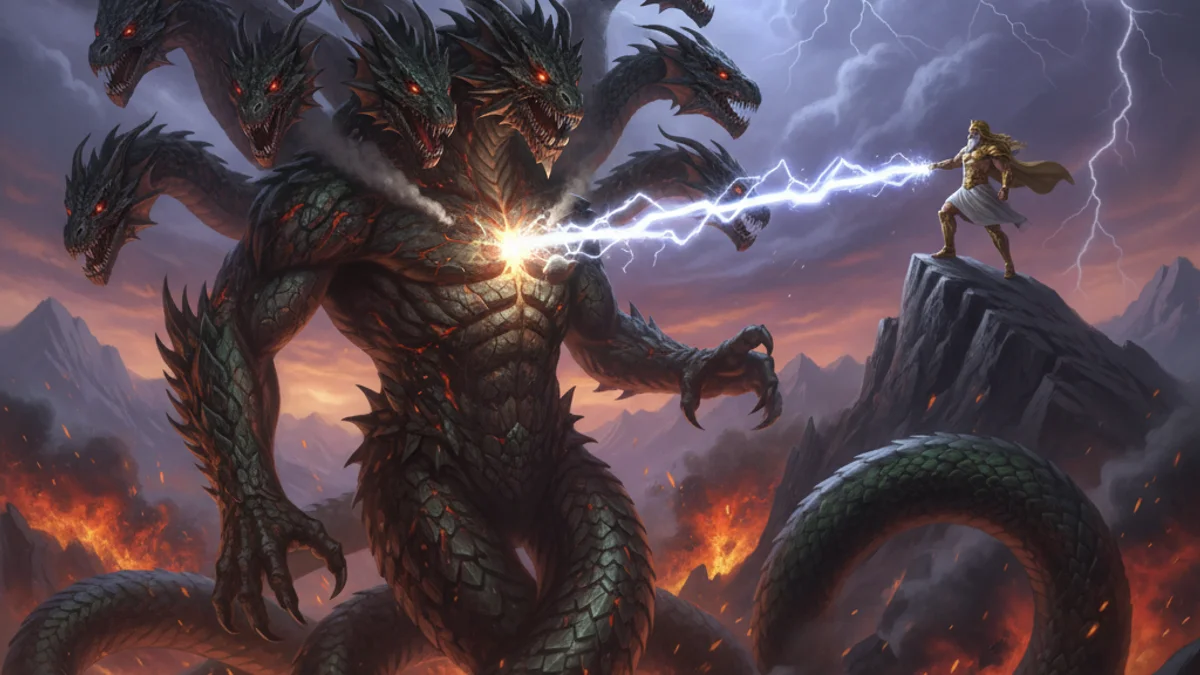
After the defeat of the Titans, Gaia, the Earth Mother, sought vengeance against the Olympian gods. From her union with Tartarus, she birthed Typhon, the most fearsome monster in existence. Typhon was a colossus with a hundred dragon heads, eyes that flashed fire, and serpentine coils for legs. When he stormed Mount Olympus, his roar was so terrifying that most gods fled to Egypt, transforming into animals to hide. Only Zeus remained to defend the heavens. The ensuing battle shook the foundations of the universe. Initially, Typhon managed to overpower Zeus, cutting out his tendons and leaving him helpless. However, the clever Hermes and Aegipan recovered the tendons and restored the king of gods. Reinvigorated, Zeus unleashed his full power, hurlng thunderbolts that scorched the earth. He finally cornered the monster in Sicily and crushed him under the massive weight of Mount Etna. Though defeated, Typhon’s restless anger remains, fueling the mountain's volcanic eruptions.
The struggle between order and chaos is eternal, and true leadership requires the courage to face even the most overwhelming terrors.
Questions about this story
What is the moral of Typhon the Monster?
The story emphasizes that order must constantly defend itself against chaos. It also suggests that even the greatest leaders must face their ultimate fears to protect their people.
Who is the father of Typhon?
In most myths, Typhon is the son of Gaia (Earth) and Tartarus (the abyss), created specifically to overthrow the Olympian gods.
Why did the Greek gods flee to Egypt?
They were so terrified by Typhon's immense size and power that they fled to Egypt and disguised themselves as animals to escape his notice.
Is Typhon considered the 'Father of Monsters'?
Yes, Typhon and his mate Echidna are credited with birthing many famous Greek monsters, including Cerberus, the Hydra, and the Chimera.
Advertisement

Good night.
