
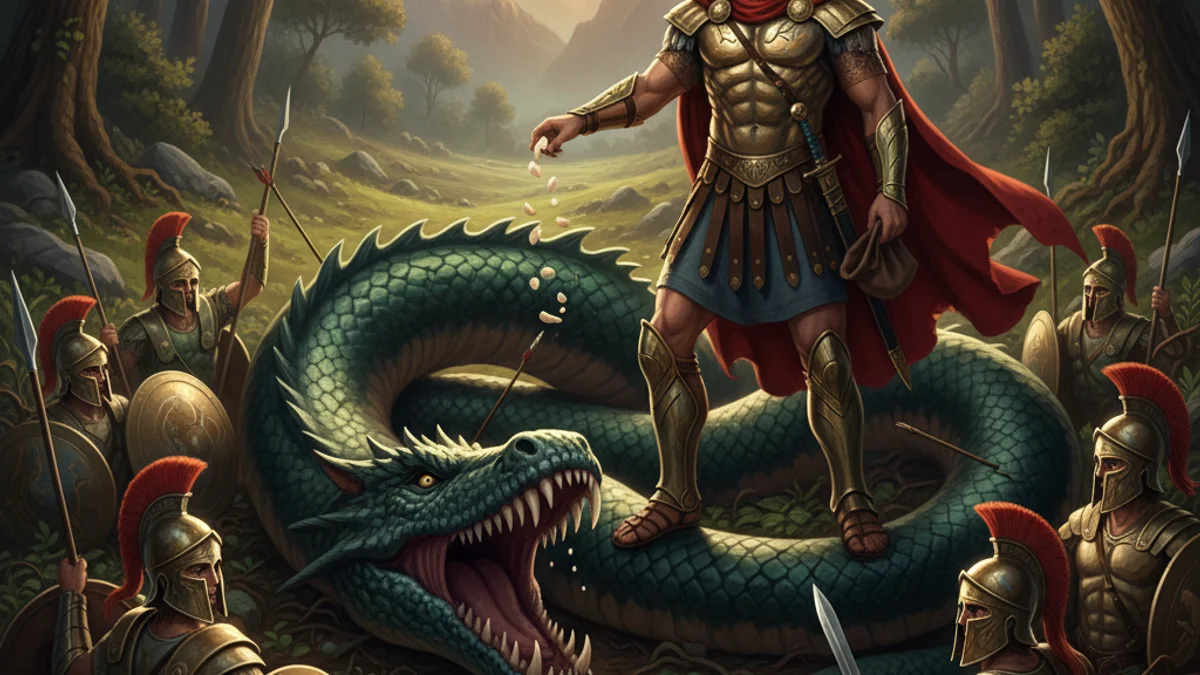
After his sister Europa was spirited away by Zeus, the Phoenician prince Cadmus searched the world for her. Guided by the Oracle of Delphi, he followed a heifer until she collapsed from exhaustion in Boeotia, marking the site for a new city. While seeking water for a sacrifice, Cadmus's men were devoured by a monstrous dragon sacred to Ares. Undaunted, the prince engaged the beast in a grueling battle, eventually piercing its heart with his spear. Athena appeared and instructed him to sow the dragon's teeth into the earth. As he did, a crop of armed warriors, the Spartoi, sprang from the soil. Cadmus threw a stone among them, causing them to fight one another in confusion until only five remained. These survivors pledged their loyalty to Cadmus, helping him build the Cadmeia, the citadel that would become the great city of Thebes.
True leadership and the birth of civilization require both the courage to face monstrous challenges and the wisdom to turn conflict into cooperation.
Questions about this story
What is the moral of Cadmus and the Dragon's Teeth?
The story emphasizes that building something lasting requires overcoming immense hardship and transforming chaotic energy into a structured society. It also highlights the importance of divine guidance and resourcefulness in the face of impossible odds.
Who were the Spartoi in Greek mythology?
The Spartoi, or 'Sown Men,' were a race of fierce warriors who sprang fully armed from the earth after Cadmus sowed the teeth of an Ismenian dragon. The five survivors became the noble ancestors of the Theban aristocracy.
Why did Cadmus have to kill the dragon?
The dragon was a son of Ares that guarded a sacred spring, and it had killed Cadmus's companions when they went to fetch water. Killing the beast was a necessary trial to secure the land for his future city.
What city did Cadmus found?
Cadmus founded the city of Thebes, initially known as the Cadmeia. It became one of the most powerful and storied city-states in ancient Greece, central to many other famous myths.
Advertisement

Good night.
