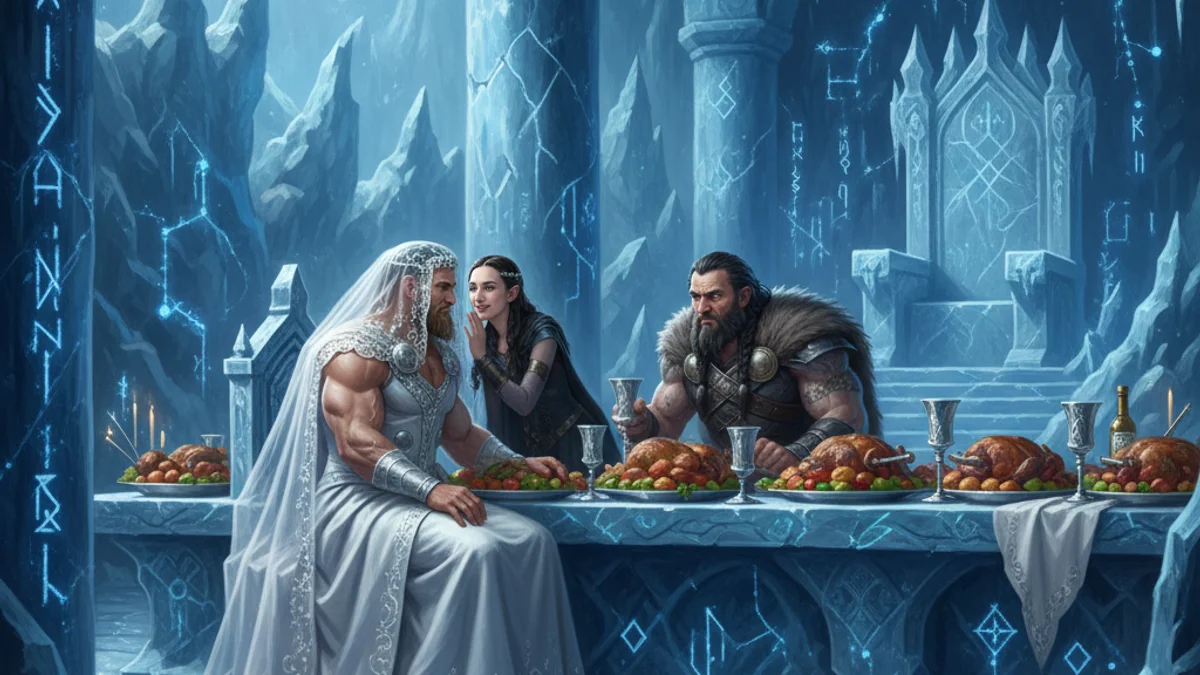
One morning, Thor, the God of Thunder, awoke to find his mighty hammer, Mjölnir, missing. Panic struck Asgard, for without it, the gods were vulnerable. Loki, the trickster, flew to Jotunheim and discovered that the giant king Thrym had stolen the weapon, burying it deep underground. Thrym’s price for its return was the hand of the beautiful goddess Freya in marriage. When Freya indignantly refused, the wise Heimdall suggested a bold plan: Thor must disguise himself as the bride. Clad in a wedding dress and a thick veil, Thor traveled to the land of the giants, accompanied by Loki disguised as his handmaid. At the wedding feast, Thor’s massive appetite nearly betrayed him, but Loki quickly explained that 'Freya' had not eaten for eight days out of excitement. When Thrym called for Mjölnir to hallow the union, the hammer was placed in Thor’s lap. Feeling the cold iron, Thor threw off his veil, gripped the handle, and unleashed his fury, defeating Thrym and the giants before returning triumphantly to Asgard.
Strength and power are useless if they are lost to carelessness, and reclaiming them often requires humility, patience, and clever strategy.
Questions about this story
What is the moral of Thor's Stolen Hammer?
The story teaches that brute force is not always the answer and that one must sometimes use wit and swallow their pride to overcome a challenge. It highlights the importance of adaptability when facing a crisis.
Who stole Thor's hammer and why?
The frost giant king Thrym stole Mjölnir while Thor slept. He hid the hammer as leverage to force the gods into giving him the goddess Freya as his wife.
Why did Thor dress as a woman?
Since Freya refused to marry a giant, Thor had to pose as her to infiltrate Thrym's hall. It was the only way to get close enough to the hammer to reclaim it before the giants realized the deception.
How did Loki help Thor in this myth?
Loki acted as Thor's 'handmaid' and used his silver tongue to explain away Thor's un-ladylike behavior. He prevented Thrym from discovering the truth when Thor ate an entire ox and three barrels of mead.
Advertisement
Good night.
