
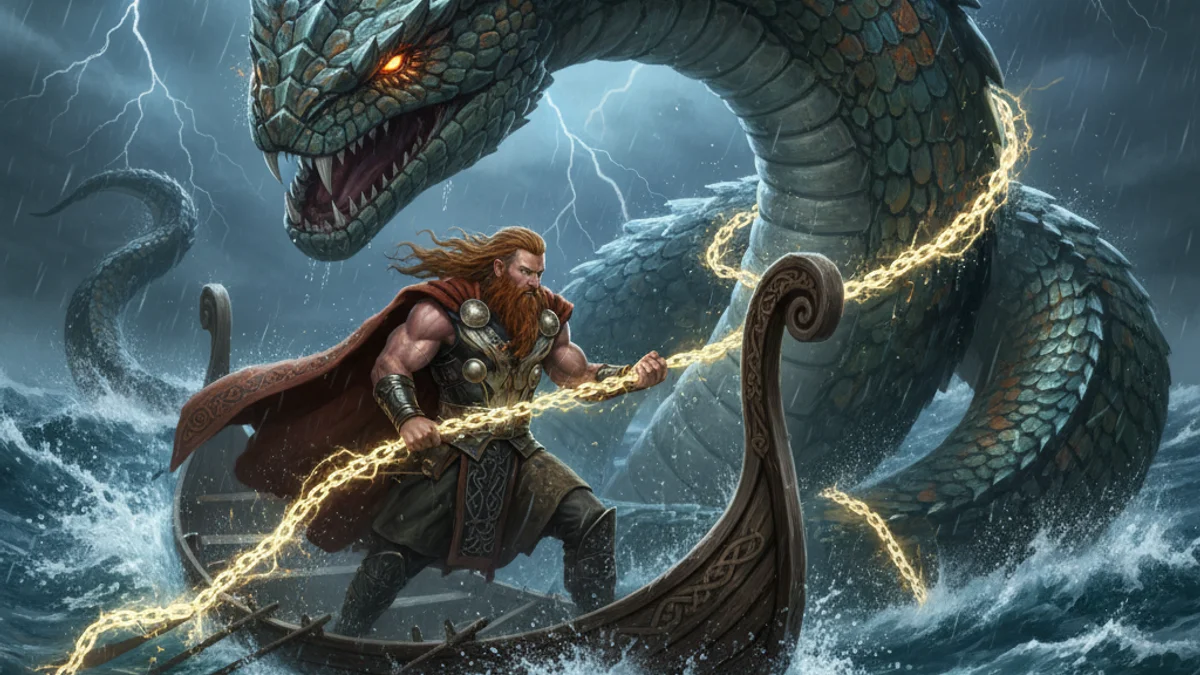
In the realm of Norse myth, the God of Thunder, Thor, shared a bitter destiny with Jormungandr, the Great Serpent that encircled Midgard. Their most famous encounter began when Thor disguised himself as a young man to join the giant Hymir on a fishing trip. Disregarding the giant's warnings, Thor rowed their boat into the deepest, darkest waters. For bait, Thor used the head of Hymir’s finest ox. Deep below, the World Serpent bit. As Thor hauled the line with divine strength, the floor of the boat gave way, and he stood on the seabed. Just as Thor raised Mjolnir to strike the serpent’s head, the terrified Hymir cut the line, allowing the beast to sink back into the depths. Their rivalry would not truly end until Ragnarok, where Thor finally slew the beast with a mighty blow, only to succumb to its venom after taking nine final steps.
Even the greatest strength cannot override the hand of destiny or the inevitable consequences of cosmic balance.
Questions about this story
What is the moral of Thor and Jormungandr?
The story emphasizes that fate is unavoidable and that even the most powerful beings are subject to the natural cycle of life and death. It also warns against the dangers of pride and unchecked rivalry.
Who is Jormungandr in Norse mythology?
Jormungandr, also known as the Midgard Serpent, is one of the three children of Loki and the giantess Angrboda. He is so large that he encircles the world and bites his own tail.
How does the final battle between Thor and Jormungandr end?
During Ragnarok, the twilight of the gods, Thor kills Jormungandr with his hammer, Mjolnir. However, the serpent's venom is so potent that Thor only walks nine steps before falling dead himself.
Why did Thor go fishing for the serpent?
Thor sought to prove his strength and bravery by capturing the ultimate monster. His journey with the giant Hymir was driven by a desire to confront the beast that represented his ultimate challenge.
Advertisement
Good night.
