
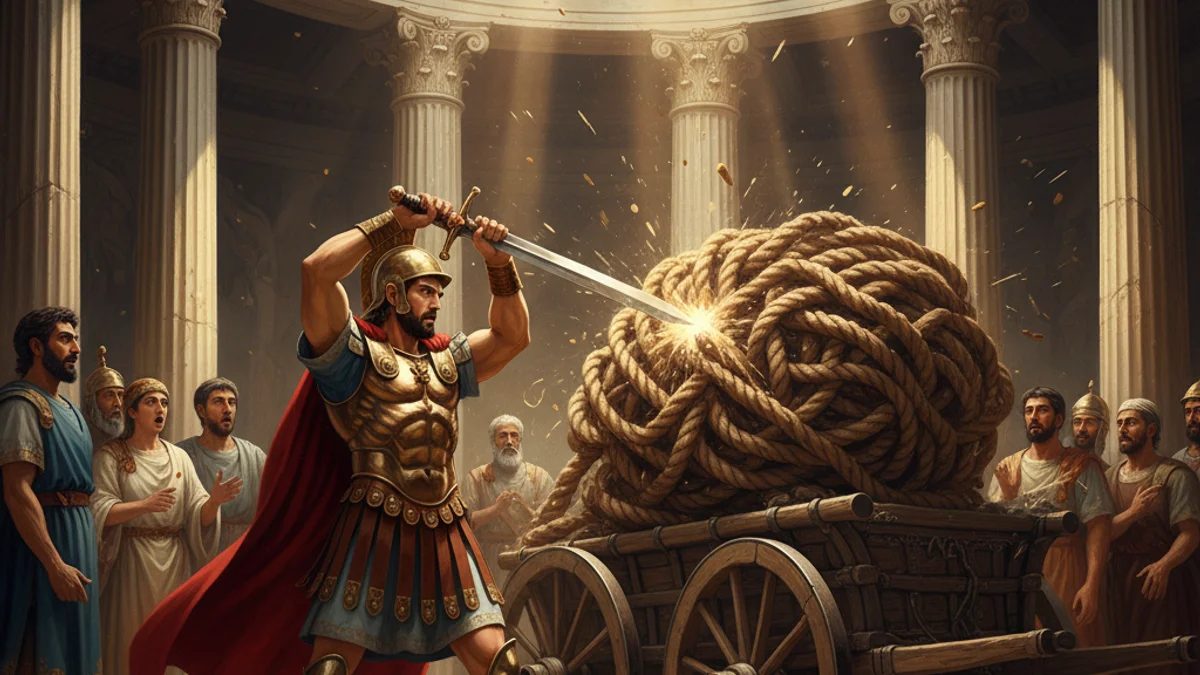
In the winter of 333 BC, Alexander the Great arrived in the Phrygian city of Gordium. In the city's acropolis stood an ancient wagon, its yoke fastened to a pole by a knot of cornel bark so complex that no one could see where the ends were hidden. A prophecy stated that whoever could untie this 'Gordian Knot' was destined to rule all of Asia. Many ambitious men had tried to unravel the tangle, but all had failed. Alexander, never one to shy away from a challenge, stepped forward to examine the knot. After a moment of contemplation, he realized that traditional methods would not suffice. Rather than fumbling with the strands, he drew his sword and, with a single powerful stroke, sliced the knot in two. By breaking the rules of the puzzle, he claimed the prize and continued his march to conquer the known world.
True leaders find bold, unconventional solutions to problems that appear impossible through traditional thinking.
Advertisement
Questions about this story
What is the moral of Alexander and the Gordian Knot?
The story teaches that some problems require a 'think outside the box' approach. Instead of being bogged down by complexity, bold and decisive action can cut through to the solution.
Who originally tied the Gordian Knot?
The knot was tied by Gordias, a poor peasant who became king of Phrygia, to dedicate his wagon to the gods.
What does the phrase 'cutting the Gordian Knot' mean today?
It is a common metaphor for finding a quick, bold solution to an extremely complex or seemingly unsolvable problem.
Where did the story of the Gordian Knot take place?
The event took place in Gordium, the capital of Phrygia, which is located in modern-day Turkey.
Advertisement
