
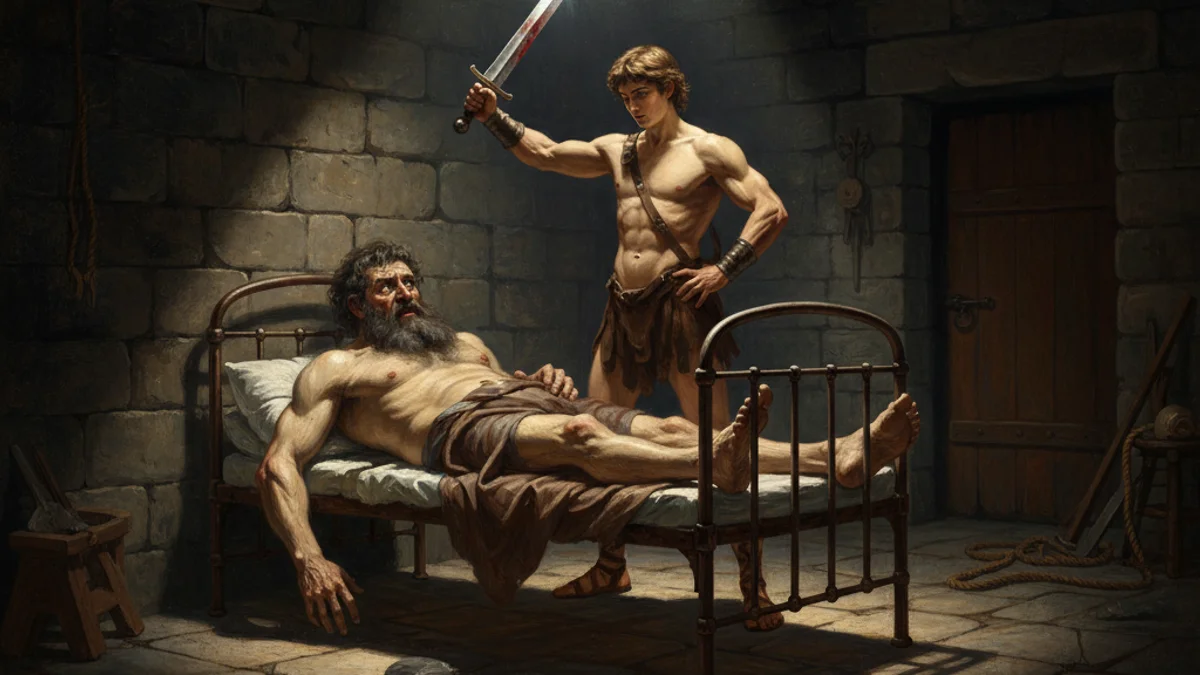
On his journey from Troezen to Athens, the young hero Theseus encountered several bandits who terrorized the coastal road. The most sinister was Procrustes, known as 'The Stretcher.' Procrustes invited weary travelers into his home, offering them a legendary bed that he claimed would fit anyone perfectly. However, the hospitality was a deadly trap. If a guest was too short for the iron bed, Procrustes would hammer and stretch their limbs until they fit the frame. If they were too tall, he would amputate their feet and legs to match its length. When Theseus arrived, he saw through the villain's cruelty. Engaging the bandit in a struggle, Theseus overpowered him and forced Procrustes onto his own bed. Finding the giant too large for the frame, Theseus applied the bandit’s own brand of justice, ending the reign of terror by cutting him down to size. This labor marked Theseus as a true protector of the people, proving that those who live by the sword shall perish by it.
Justice is served when the cruel are forced to endure the very standards and sufferings they imposed on others.
Questions about this story
What is the moral of Theseus and Procrustes?
The story illustrates the concept of poetic justice, where a villain suffers the exact fate they intended for others. It also warns against forced conformity and the dangers of imposing rigid, arbitrary standards on others.
What does the word 'Procrustean' mean today?
It refers to a 'Procrustean bed,' describing a situation where different things are forced into a single, arbitrary scheme or pattern. It implies a disregard for individual differences in favor of ruthless, violent uniformity.
How did Theseus kill Procrustes?
Theseus used Procrustes' own method against him by forcing him onto the iron bed. Since the bandit was too large for his own device, Theseus chopped off his head and limbs to make him fit, ending his life.
Is Procrustes considered one of the Labors of Theseus?
Yes, this encounter was the last of the six 'labors' Theseus performed while traveling the coastal road from Troezen to Athens. Each labor involved defeating a dangerous outlaw or monster that plagued the region.
Advertisement

Good night.
