
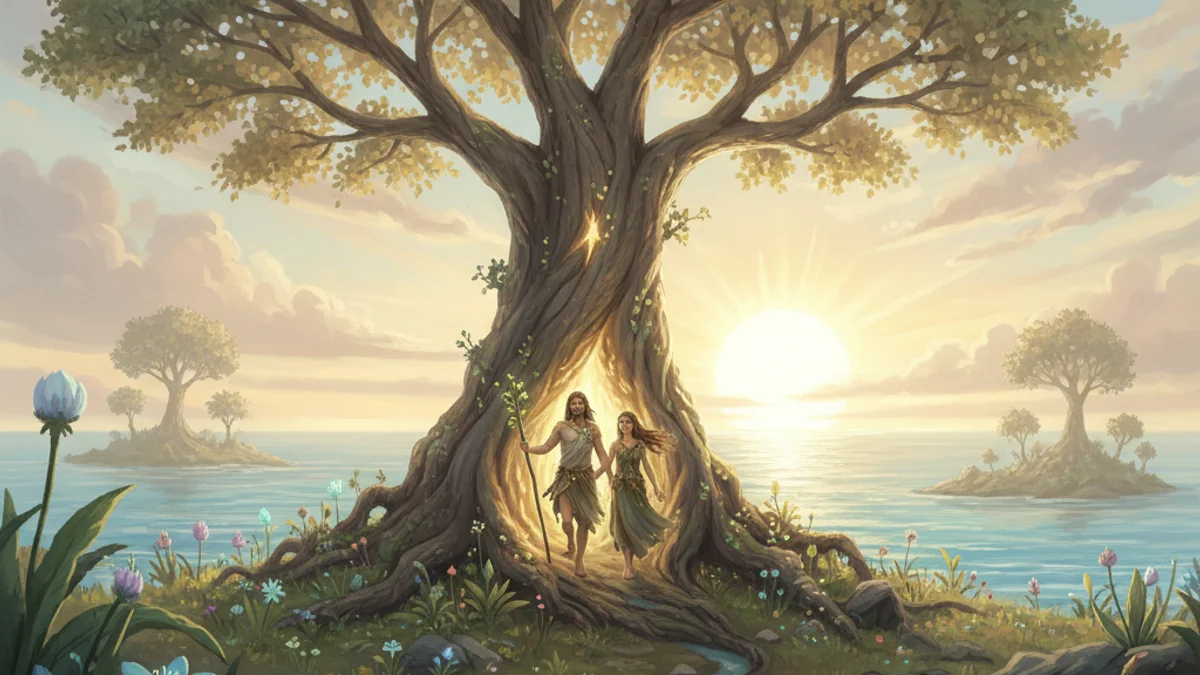
After the fires of Surtr had consumed the nine realms and the great winter had frozen the hearts of many, a profound silence fell over the void. But the end was not final. From the depths of the grey sea, a new earth began to rise, vibrant and green. The sun, before being swallowed by the wolf, had given birth to a daughter even more beautiful than herself, who now climbed the heavens to light the world anew. In the protective boughs of Yggdrasil, the world tree, two humans named Lif and Lifthrasir had survived by huddling together, nourished by the morning dew. As they stepped out onto the fresh grass, they found the gods who remained: Vidar and Vali, and the sons of Thor, Magni and Modi, bearing their father's hammer Mjolnir. Even the beloved Baldur and his brother Hod returned from the halls of Hel. Together, they sat in the sun-drenched meadows of Ida and found the golden chess pieces used by the gods of old. They spoke of the past and built a new home, beginning a cycle of peace where fields would grow without being sown and sorrow would be a distant memory.
Destruction is often the precursor to creation, teaching us that hope and life are resilient even in the face of total cataclysm.
Questions about this story
What is the moral of The World Reborn?
The story emphasizes that life is cyclical and that even after total destruction, there is hope for a peaceful rebirth. It teaches us that resilience and renewal are fundamental parts of the universe's nature.
Who are the humans who survive Ragnarok?
Lif and Lifthrasir are the two humans who survive by hiding within the trunk of the world tree, Yggdrasil. They become the ancestors of the new human race in the reborn world.
Which gods return after the destruction of Asgard?
The survivors include Odin's sons Vidar and Vali, Thor's sons Magni and Modi, and the resurrected brothers Baldur and Hod. They lead the new pantheon in a spirit of harmony.
What happens to the world after the fire of Surtr?
The old world is cleansed by fire and sinks into the sea, but it eventually rises again, purified and fertile. The new earth is described as a paradise where crops grow naturally without labor.
Advertisement
Good night.
