
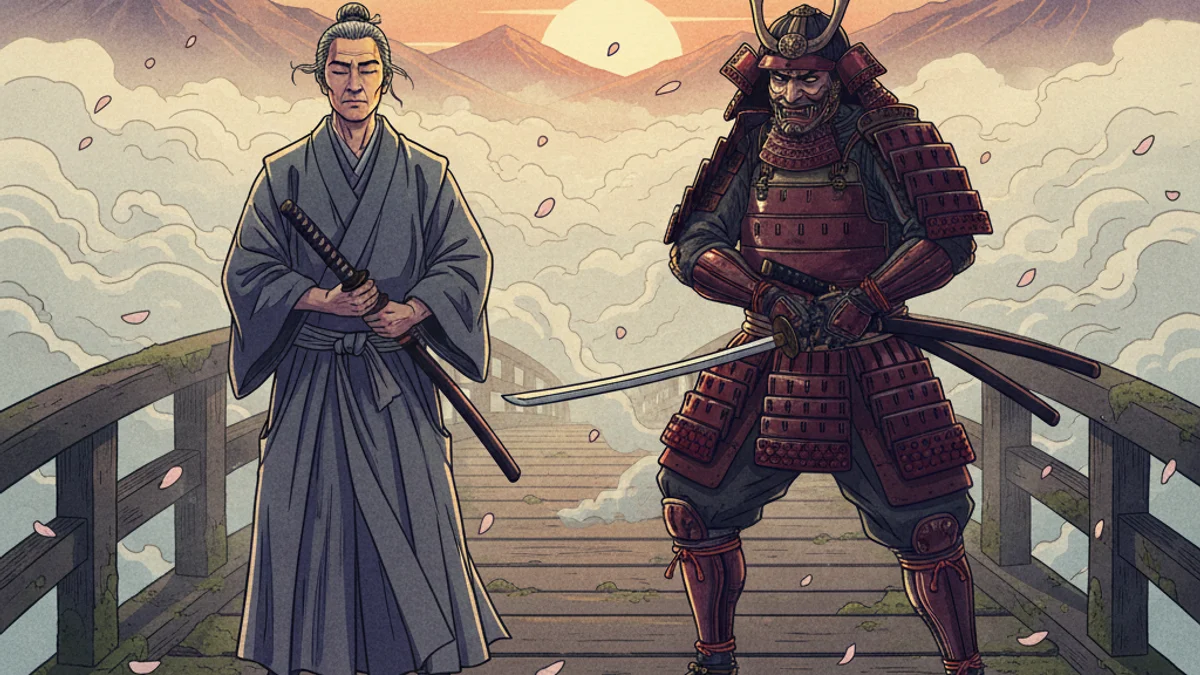
In the service of Lord Yamanouchi, a humble tea master was once forced to travel to the capital dressed in the robes of a samurai to maintain appearances. While walking through the city, he was intercepted by a boisterous and cruel Ronin who challenged him to a duel to test his mettle. Knowing nothing of the sword, the tea master visited a local swordmaster, asking only how to die with dignity. The swordmaster, observing the man's perfect, trembling-free tea service, realized his discipline was already his greatest weapon. He instructed the tea master to clear his mind of fear and treat the duel exactly like a tea ceremony. On the day of the confrontation, the tea master stood before the warrior with absolute stillness, a tranquil gaze, and a steady hand. Perceiving a man who had completely conquered his own fear, the Ronin saw a master without a single opening. Fearing a deadly counter-strike from such an unnervingly composed opponent, the Ronin bowed, apologized, and fled. The tea master had won the battle without ever drawing his blade.
True mastery and inner peace are more powerful than physical aggression; a disciplined mind leaves no opening for an enemy to exploit.
Questions about this story
What is the moral of The Tea Master and the Ronin?
The moral is that internal discipline and a calm mind are the ultimate forms of strength. It teaches that presence and focus can overcome raw aggression and physical skill.
Who was the Tea Master in the legend?
He was a humble servant of Lord Yamanouchi who, despite having no martial training, possessed a high level of Zen-like focus through his dedication to the tea ceremony.
Did the tea master actually know how to fight?
No, he had never trained in swordsmanship and was initially terrified. He relied entirely on the principles of focus and 'no-mind' that he practiced in his daily craft.
Is The Tea Master and the Ronin a true story?
While rooted in the cultural history of the Edo period, it is considered a teaching parable. It serves to illustrate the intersection of Zen Buddhism and the martial arts of Japan.
Advertisement
Teach next
Good night.
