
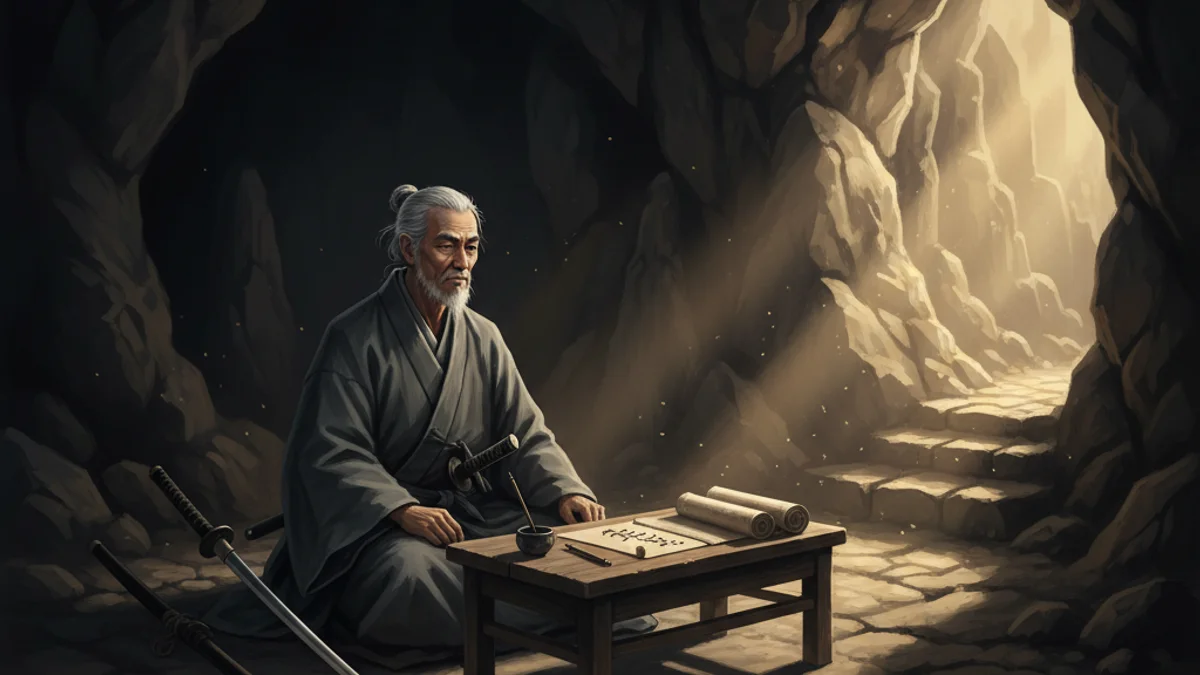
In the twilight of his life, the undefeated dual-wielding swordsman Miyamoto Musashi retreated to the Reigandō cave in the mountains of Kyushu. After sixty successful duels, he sought to distill a lifetime of combat into a guide for his student, Terao Magonojo. He divided his wisdom into five scrolls: Earth, Water, Fire, Wind, and Void. Through Earth, he taught the foundations of timing; through Water, the fluid nature of the spirit; through Fire, the heat of battle; through Wind, the styles of others; and through Void, the spiritual essence of nothingness. He wrote not just of the sword, but of the Way, illustrating that a true master perceives the rhythm of all things—from the movement of an army to the strokes of a painter’s brush.
True mastery is found in the harmony of strategy, discipline, and the ability to apply the principles of one's craft to every aspect of life.
Advertisement
Questions about this story
What is the moral of Musashi's Book of Five Rings?
The moral is that strategy and mastery are universal; by understanding the 'Way' in one thing, you can see it in all things. It emphasizes discipline and mental clarity over brute force.
What are the five elements in Musashi's book?
The elements are Earth (timing/foundation), Water (flexibility/spirit), Fire (battle tactics), Wind (knowing your opponent), and Void (the spiritual essence and nature of things).
Where did Musashi write the Book of Five Rings?
He wrote it while living as a hermit in the Reigandō cave, located in Kumamoto, Japan, during the final years of his life.
Is the Book of Five Rings still used today?
Yes, it is widely read by business leaders, athletes, and martial artists for its insights into psychology, strategy, and conflict resolution.
Advertisement
