
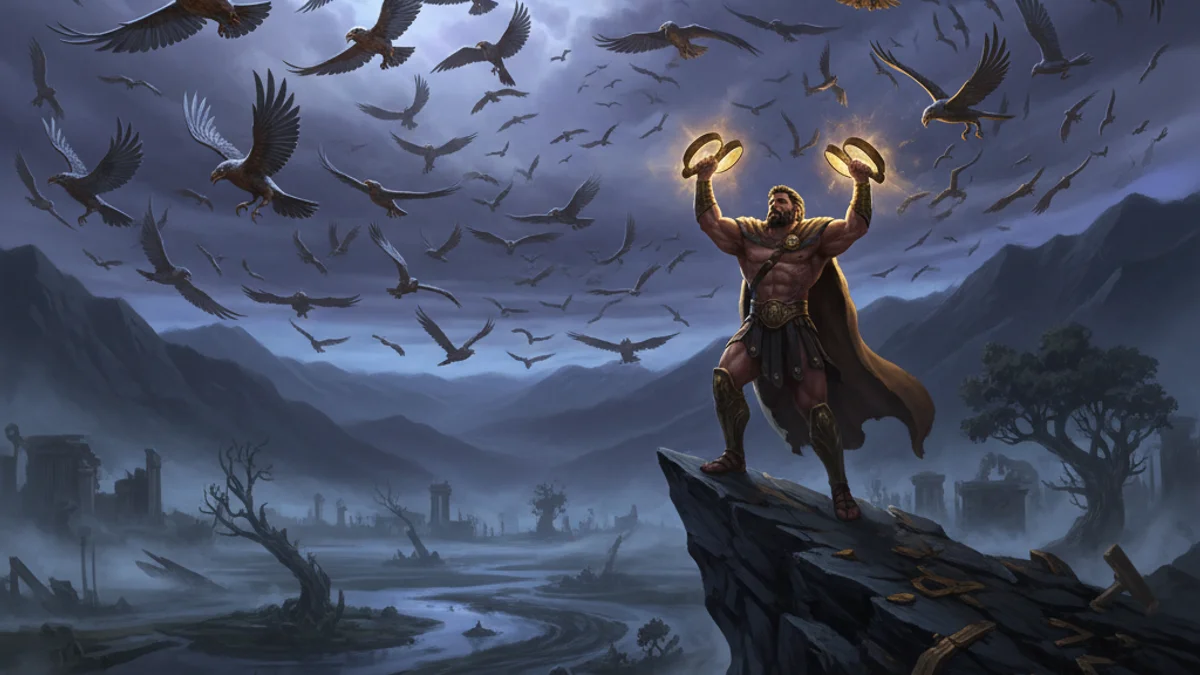
For his sixth labor, Hercules was sent to the deep forests of Arcadia to purge Lake Stymphalus of its most terrifying inhabitants: the Stymphalian Birds. These were no ordinary creatures; they were man-eating monsters with beaks of bronze and feathers of sharp, metallic steel that they could launch like arrows from the sky. Their toxic dung blighted the crops, and their sheer numbers darkened the sun. When Hercules reached the marsh, he found the ground too soft to support his weight and too dense for a boat. Trapped on the shore, he could not reach the birds hiding in the thick reeds. Seeing his struggle, the goddess Athena provided him with krotala—bronze castanets forged by the god Hephaestus. Standing on a nearby mountain, Hercules clashed the instruments together with a deafening, supernatural din. Terrified by the celestial noise, the birds took to the air in a panicked swarm. As they filled the sky, Hercules used his bow to pick them off one by one, while the survivors fled to the Island of Ares, never to plague the lake again.
Strength is often insufficient without the right tools and the wisdom to use them effectively against overwhelming odds.
Questions about this story
What is the moral of The Stymphalian Birds?
The story teaches that resourcefulness and the use of proper tools are just as important as physical strength. Even a hero like Hercules needed divine ingenuity to solve a problem that force alone could not fix.
How did Hercules defeat the Stymphalian Birds?
Hercules used bronze castanets called krotala, given to him by Athena, to create a loud noise that scared the birds into the air. Once they were flying and visible, he was able to shoot them down with his arrows.
What were the special powers of the Stymphalian Birds?
The birds featured bronze beaks and metallic feathers that they could shoot at their prey like arrows. Additionally, their poisonous droppings destroyed crops and made the surrounding environment toxic.
Why couldn't Hercules just walk into the lake?
The Lake Stymphalus area was a treacherous marsh that was neither solid ground nor open water. It was too soft for Hercules to walk on without sinking, but too thick for a boat to navigate.
Advertisement

Good night.
