
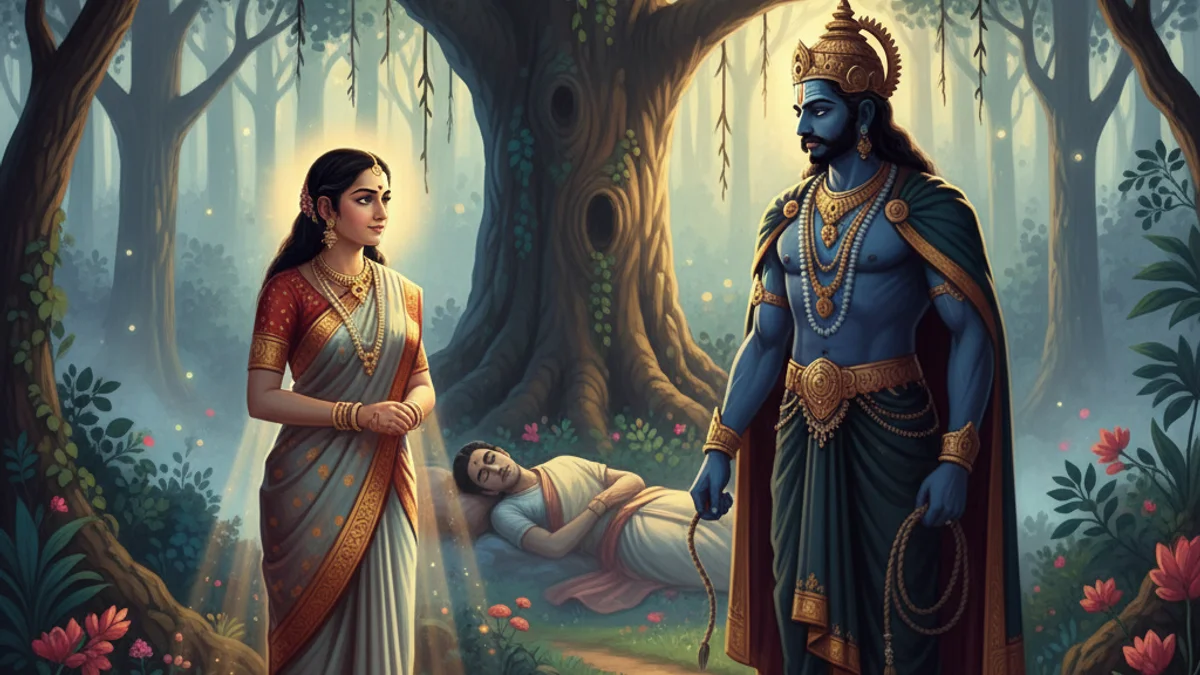
Princess Savitri, daughter of King Ashvapati, chose to marry Satyavan, a prince living in exile, despite a prophecy from the sage Narada that Satyavan would die within a year. Savitri accepted this fate and lived humbly in the forest. When the fated day arrived, Satyavan collapsed while cutting wood. Yama, the Lord of Death, appeared and carried his soul away. Refusing to let him go, Savitri followed Yama into the afterlife. Impressed by her persistence and her wise discourse on righteousness and duty, Yama offered her several boons, provided she did not ask for Satyavan's life. Savitri first asked for her father-in-law's sight and kingdom, then for her own father to have sons. Finally, she asked for a hundred sons for herself. When Yama granted this, Savitri cleverly pointed out that as a virtuous wife, she could only fulfill this boon if Satyavan were alive. Outwitted by her logic and moved by her devotion, Yama restored Satyavan to life.
Unwavering devotion, combined with intelligence and persistence, can overcome even the most certain fate.
Questions about this story
What is the moral of The Story of Savitri?
The moral is that true devotion, coupled with wisdom and mental strength, can overcome any obstacle. It highlights that one's character and intelligence are powerful enough to influence even divine fate.
Who was Savitri's husband in the story?
Savitri's husband was Satyavan, a virtuous prince who lived in the forest with his blind, exiled father. Despite knowing he would die young, Savitri chose him for his noble character.
How did Savitri outsmart Yama?
She asked for a boon to have a hundred sons. Since she was a devoted wife who would never remarry, Yama realized he had to return Satyavan to life to make the boon possible.
What boons did Yama grant Savitri?
Yama granted boons to restore her father-in-law's sight and kingdom, provide sons for her father, grant her a hundred sons, and eventually, the life of Satyavan.
Advertisement
Good night.
