
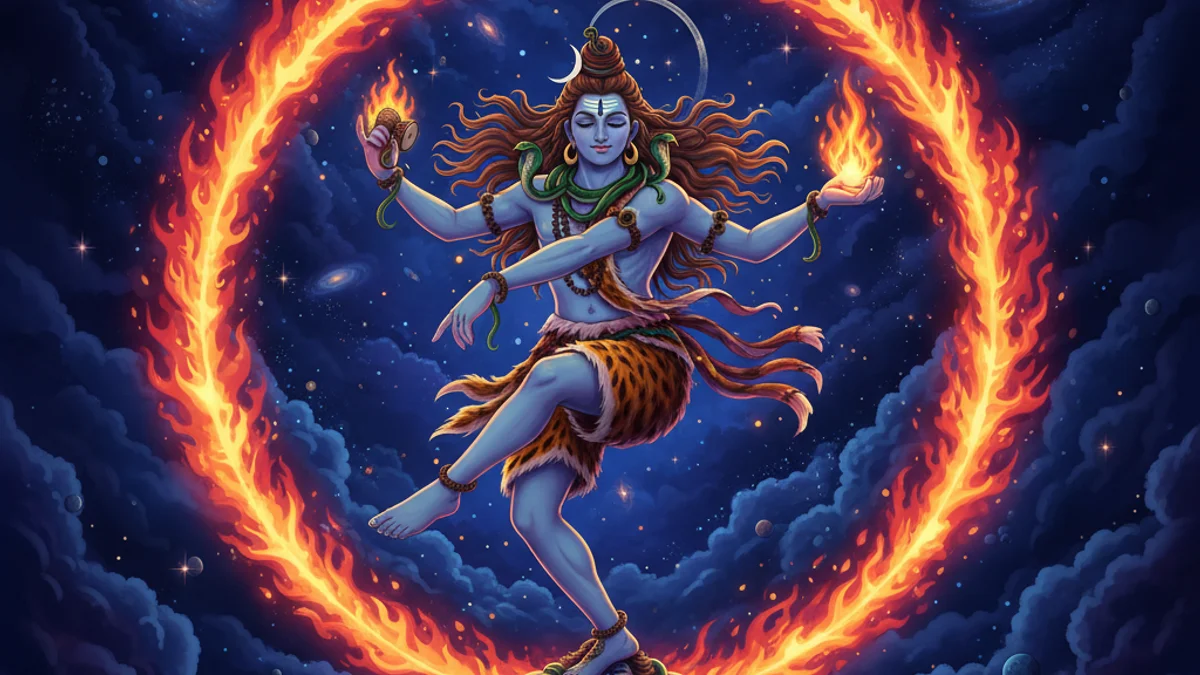
In the forest of Tillai, a group of arrogant sages believed they could control the universe through mere rituals and magic. To humble them, Lord Shiva appeared as a wandering mendicant. Enraged by his presence, the sages unleashed a series of magical attacks. First, they sent a ferocious tiger, which Shiva effortlessly skinned with his fingernail, wearing it as a shawl. Next, they sent a venomous cobra, which he wrapped around his neck as an ornament. Finally, they summoned the powerful dwarf demon Apasmara, the embodiment of ignorance and ego. Shiva leaped upon the demon's back, pinning him to the ground. In this moment of triumph, he began the Ananda Tandava—the Dance of Bliss. Surrounded by a halo of fire, Shiva moved with cosmic grace, his rhythmic steps maintaining the balance of life and death, creation and destruction. Witnessing this divine spectacle, the sages realized their folly and bowed before the Lord of Dance, understanding that true power lies in the wisdom that suppresses ignorance.
True wisdom and liberation are achieved only when one conquers the ego and suppresses the darkness of ignorance.
Questions about this story
What does the Nataraja pose symbolize?
The pose symbolizes the five principal manifestations of eternal energy: creation, destruction, preservation, salvation, and illusion.
Who is the dwarf under Shiva's feet?
The dwarf is Apasmara, a demon representing ignorance and the human ego, which must be suppressed for spiritual growth.
What is the significance of the circle of fire?
The 'Prabha Mandala' or circle of fire represents the manifest universe and the unending cycle of birth and death.
What does the drum in Shiva's hand signify?
The 'Damaru' represents the first sound of creation, the heartbeat of the universe, and the rhythm of time.
Advertisement
Good night.
