
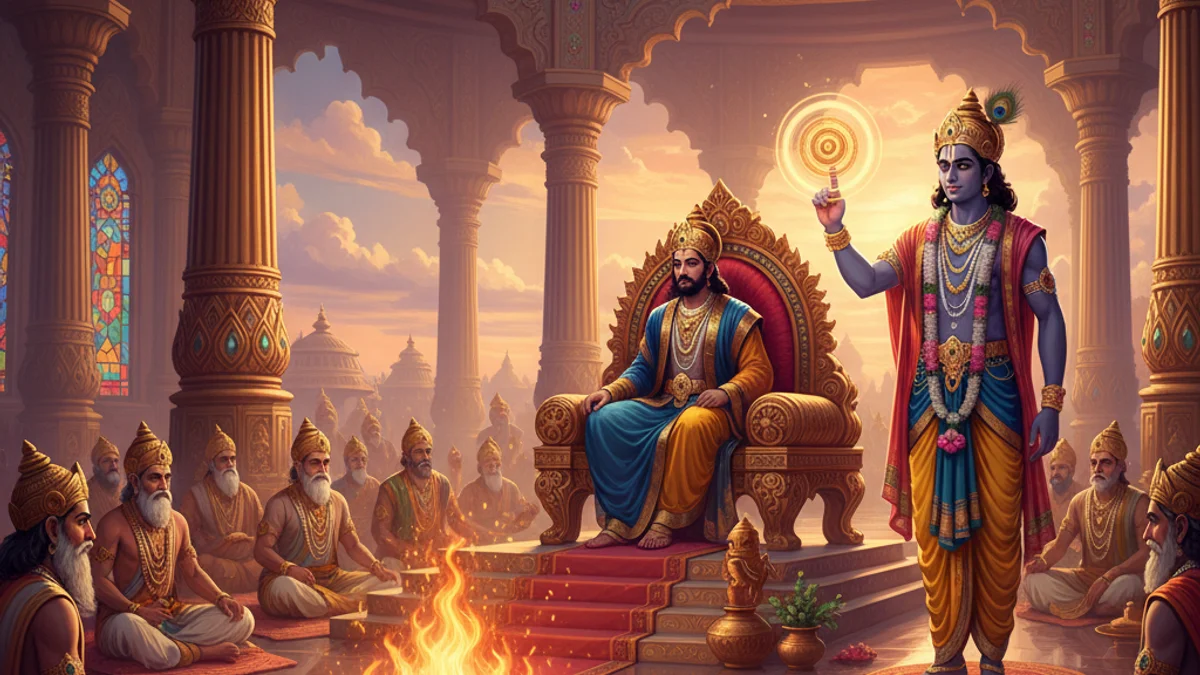
After establishing the city of Indraprastha, King Yudhishthira desired to perform the Rajasuya Yagna to be recognized as the Emperor of the world. Lord Krishna advised him that as long as the tyrant Jarasandha lived, such a sacrifice was impossible. Consequently, Krishna, Bhima, and Arjuna traveled to Magadha, where Bhima defeated Jarasandha in a wrestling match. With the path cleared, the sacrifice began in a magnificent palace built by the architect Maya Danava. Sages, kings, and gods gathered for the event. When the time came to offer the 'Agrapuja' (first honor), Sahadeva proposed Lord Krishna. Most agreed, but Shishupala, the King of Chedi, erupted in rage, hurling a hundred foul insults at Krishna and the Pandavas. Krishna, having promised Shishupala's mother to forgive a hundred sins, waited patiently. When the hundredth insult passed, Krishna released his Sudarshana Chakra, ending Shishupala's life. The sacrifice concluded successfully, but the grandeur of the 'Maya Sabha' and Yudhishthira’s ascent ignited a lethal jealousy in Duryodhana, sowing the seeds for the Great War.
True power is established through righteousness and divine grace, but even the greatest achievements can be overshadowed by the envy of others.
Questions about this story
What is the moral of The Rajasuya Sacrifice?
The story teaches that dharma triumphs over tyranny and that hubris, as shown by Shishupala, leads to inevitable downfall. It also highlights how success can trigger jealousy in those with corrupted hearts.
Why did Yudhishthira perform the Rajasuya Yagna?
He performed it to establish himself as the Chakravartin (Emperor) and to fulfill his father's wish for his sons to achieve supreme sovereignty through a righteous path.
Who was Jarasandha and why had he to be killed?
Jarasandha was the powerful King of Magadha who had imprisoned 86 kings to sacrifice them. He was a barrier to Yudhishthira's imperial claim and a threat to global peace.
Why did Krishna wait for Shishupala to finish his insults?
Krishna had promised Shishupala's mother that he would forgive 100 insults committed by her son. He waited for Shishupala to exceed that limit before taking action.
Advertisement
Good night.
