
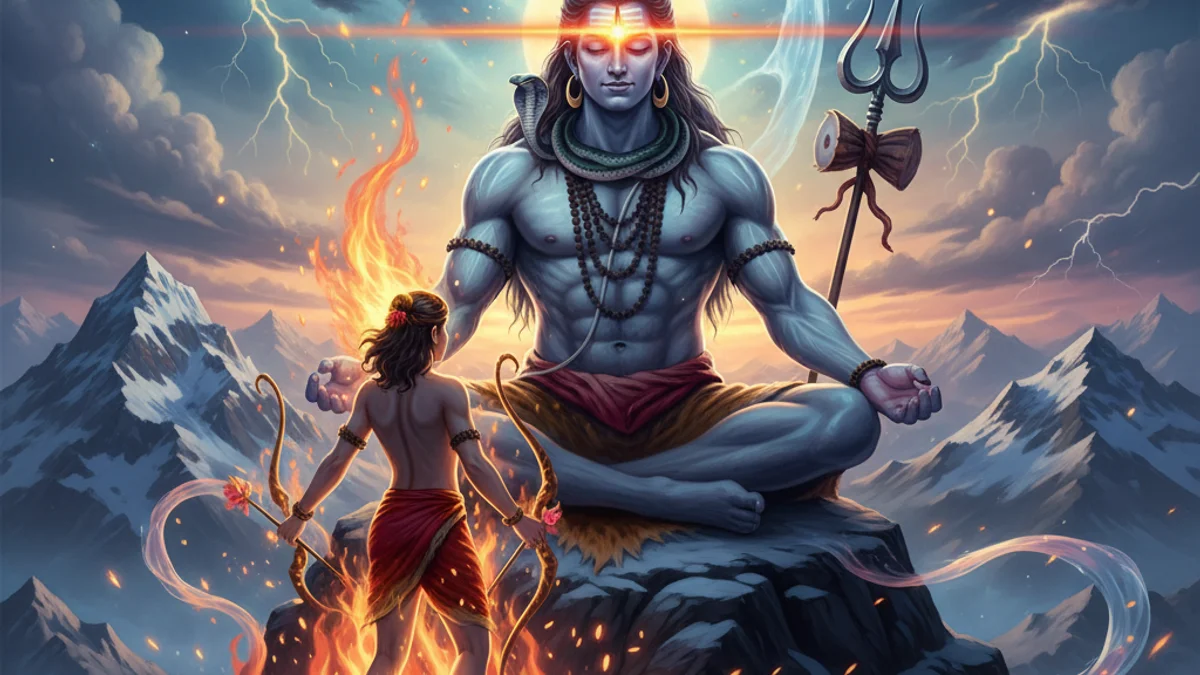
Lord Shiva sat in profound meditation on the icy peaks of Mount Kailash, detached from the worldly realm. However, the gods were in turmoil, needing Shiva to father a child who could defeat the demon Tarakasura. They sent Kamadeva, the God of Love, to break Shiva's deep trance. Kamadeva aimed an arrow of flowers at the Great Yogi, hoping to ignite desire for the goddess Parvati, who waited nearby. As the arrow struck, Shiva’s concentration broke, and a surge of divine anger rose within him. He opened his third eye—the eye of spiritual wisdom and destruction—and a beam of cosmic fire erupted, instantly incinerating Kamadeva into a pile of ash. Shiva demonstrated that while love is a cosmic force, worldly desire must be conquered by higher consciousness and self-control before spiritual union can occur.
True wisdom requires the mastery of one's senses and the destruction of ego-driven desires.
Questions about this story
What is the moral of Shiva's Third Eye?
The moral is that spiritual enlightenment and self-discipline are achieved by destroying worldly desires and ego. It emphasizes that wisdom must prevail over the distractions of the physical senses.
Why did Shiva open his third eye?
Shiva opened his third eye because he was angered by Kamadeva’s attempt to interrupt his deep meditation with an arrow of desire. The eye serves as a source of cosmic fire that destroys ignorance and evil.
Who is Kamadeva in Hindu mythology?
Kamadeva is the God of Love and Desire, often depicted with a bow of sugarcane and arrows of flowers. In this story, he represents the distractions that prevent spiritual focus.
What does Shiva's third eye symbolize?
The third eye, or 'Trinetra,' symbolizes the eye of wisdom (Jnana-Chakshu) which sees beyond the physical world. It represents the ability to perceive the ultimate truth and destroy illusion.
Advertisement
Good night.
