
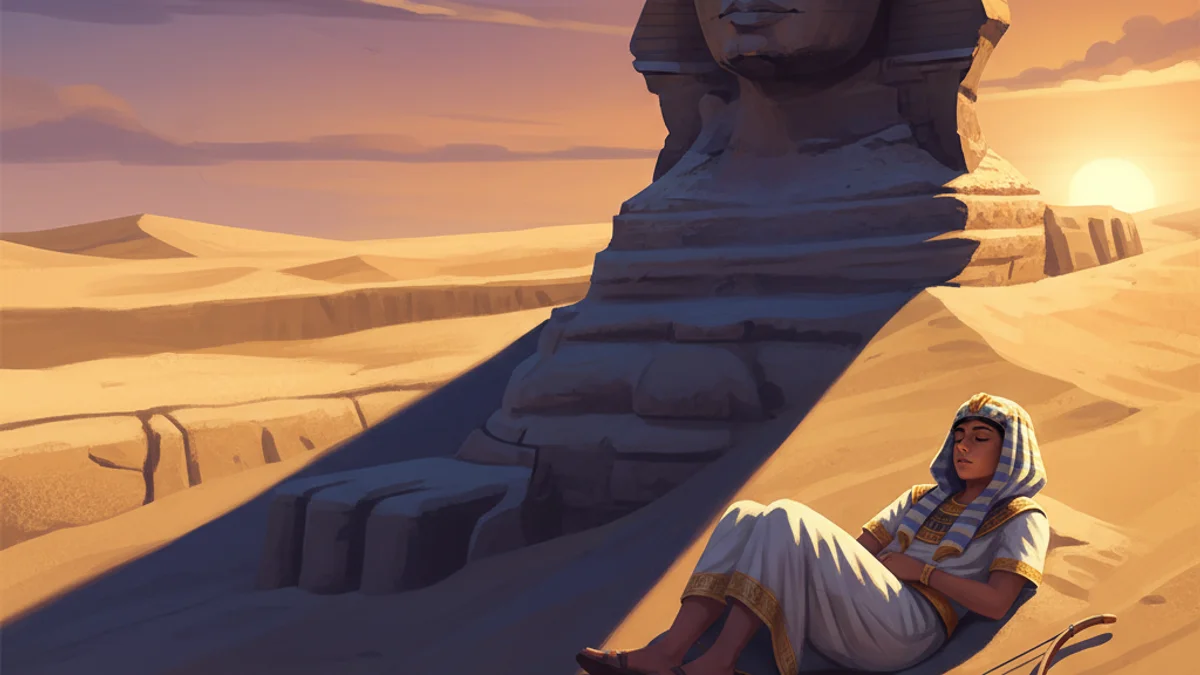
Young Prince Thutmose, a son of Amenhotep II, often escaped the court to hunt in the desert near the Great Pyramids. One afternoon, exhausted from the chase, he sought shade beneath the massive head of the Great Sphinx, which sat buried up to its neck in the drifting desert sands. As he slept, the sun god Horemakhet spoke to him in a dream, lamenting the weight of the sand pressing upon his limbs. The deity promised Thutmose that if he cleared away the encroaching dunes, he would one day wear the Double Crown of Egypt. Despite not being first in line for the throne, Thutmose obeyed the divine command. He mobilized his workers to clear the sands, restoring the monument's glory, and eventually ascended as Pharaoh Thutmose IV, immortalizing his promise on the Dream Stele placed between the Sphinx’s paws.
Honoring the divine and preserving the wonders of the past can pave the way to a glorious future.
Questions about this story
What is the moral of The Prince and the Sphinx?
It emphasizes the rewards of piety and the importance of restoring sacred monuments. By helping the god, Thutmose secured his own destiny and the throne of Egypt.
Is The Prince and the Sphinx a true story?
While based on the historical Thutmose IV, it is considered a legitimization myth. However, the physical evidence of the story remains on the Dream Stele found between the Sphinx's paws.
Who was the prince in the story?
The prince was Thutmose IV, a Pharaoh of the Eighteenth Dynasty. Historical evidence suggests he may not have been the original heir, making this divine prophecy very important for his reign.
What is the Dream Stele?
The Dream Stele is an inscribed stone tablet found at Giza. It was erected by Thutmose IV in the first year of his reign to document his encounter with the sun god.
Advertisement
Good night.
