
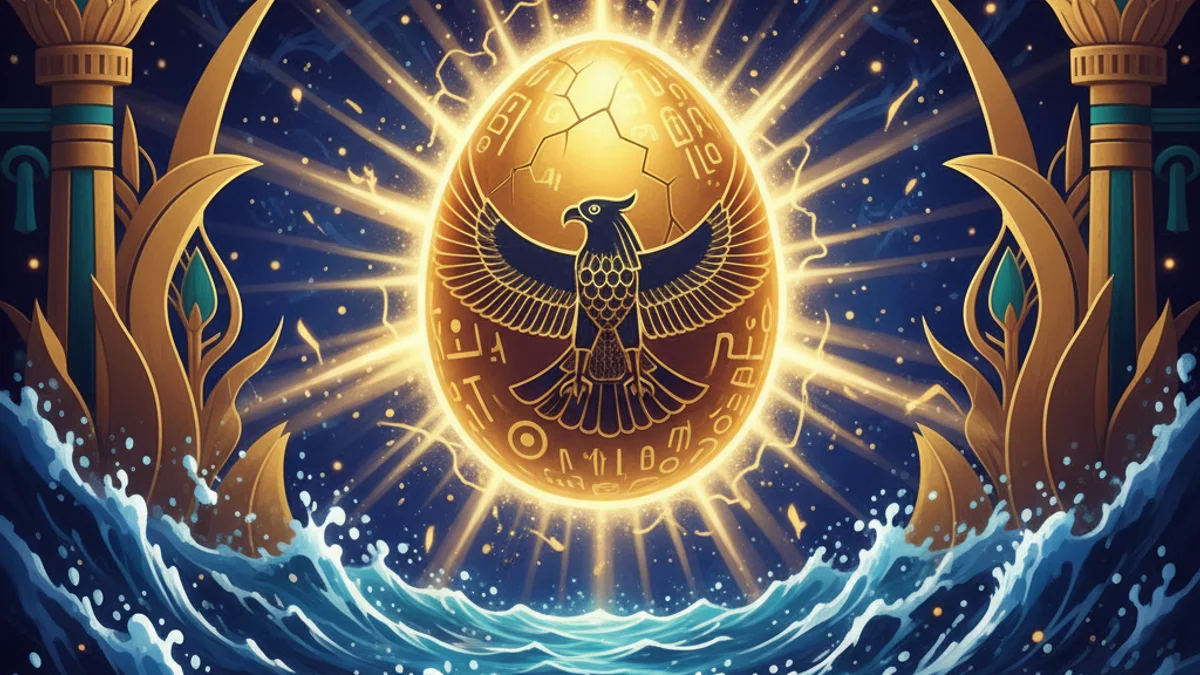
Before time began, there was only Nun—the vast, silent, and dark primeval waters of chaos. From these depths, a mound of earth known as the Benben rose. Upon this sacred mound, a celestial bird—often depicted as an ibis or a goose known as the Great Cackler—laid a shimmering golden egg. For ages, the egg rested in the stillness of the void until it finally cracked. From within the shell burst forth Ra, the radiant Sun God, whose brilliant light scattered the shadows of the deep. Ra's emergence brought the first sunrise, establishing Ma'at, the divine order, and signaling the beginning of all life. The fragments of the shell were said to become the sky and the earth, forever separating the celestial realm from the waters below.
Out of chaos and darkness, order and light can emerge through the spark of creation.
Questions about this story
What is the moral of The Cosmic Egg?
The moral is that even in total chaos, there is the potential for life, order, and light to begin. It teaches that every great ending or void holds the seed for a new beginning.
Who laid the Cosmic Egg in Egyptian mythology?
In many versions, the egg was laid by a celestial goose known as the 'Great Cackler' or by an ibis, which is often associated with the god Thoth. This act broke the eternal silence of the primeval waters.
What deity was born from the Cosmic Egg?
The sun god Ra (sometimes identified as Atum or Amun) emerged from the egg. His birth brought the first light to the universe and ended the reign of darkness.
What does Nun represent in the story?
Nun represents the watery abyss or primeval chaos that existed before the world was formed. It is the source of all that exists but lacks form or direction until Ra emerges.
Advertisement
Good night.
