
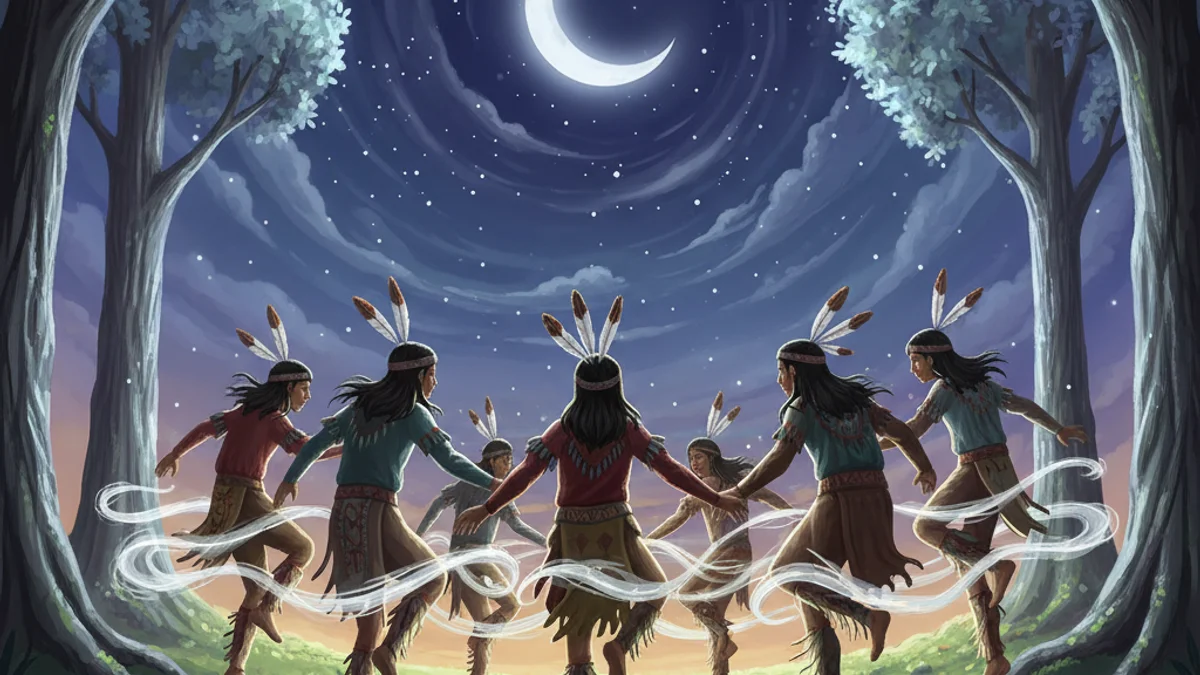
Long ago, seven boys spent all their days playing the gatayu’stĭ game and dancing in the town square, neglecting their chores and the hunt. Their mothers, frustrated by their laziness, decided to teach them a lesson. When the boys came home hungry, their mothers served them boiled stones for dinner, saying that if they preferred play to work, they should eat their game stones. Hurt and angry, the boys returned to the square and began to dance with a rhythmic, supernatural intensity. As they whirled faster and faster, their feet began to lift off the ground. They rose slowly into the air, drifting higher toward the heavens. One mother, seeing her son ascending, managed to grab him with a garden tool and pull him back to Earth, but he struck the ground with such force that he sank into the soil and grew into a pine tree. The other six boys continued their ascent until they reached the sky, becoming the shimmering cluster of stars known as the Pleiades, watching over the world they left behind.
One must balance the joy of play with the necessity of responsibility, or risk losing their connection to home and family.
Questions about this story
What is the moral of The Pleiades?
The moral is that while joy and play are important, neglecting one's duties and family can lead to permanent separation. It teaches that balance between work and leisure is essential for a harmonious life.
Which Native American tribe tells this version of The Pleiades?
This specific version is most commonly associated with the Cherokee and Onondaga peoples. Many different North American tribes have their own unique variations of how these stars were formed.
Why did the boys turn into stars?
The boys turned into stars because they were so focused on their dance and so hurt by their parents' discipline that they transcended the physical world. Their rhythmic dance gave them the power to rise into the sky.
What happened to the seventh boy in the legend?
In many versions, the seventh boy is pulled back to Earth by his mother. However, he does not return to human form; instead, he sinks into the earth and transforms into the first pine tree.
Advertisement
Good night.
