
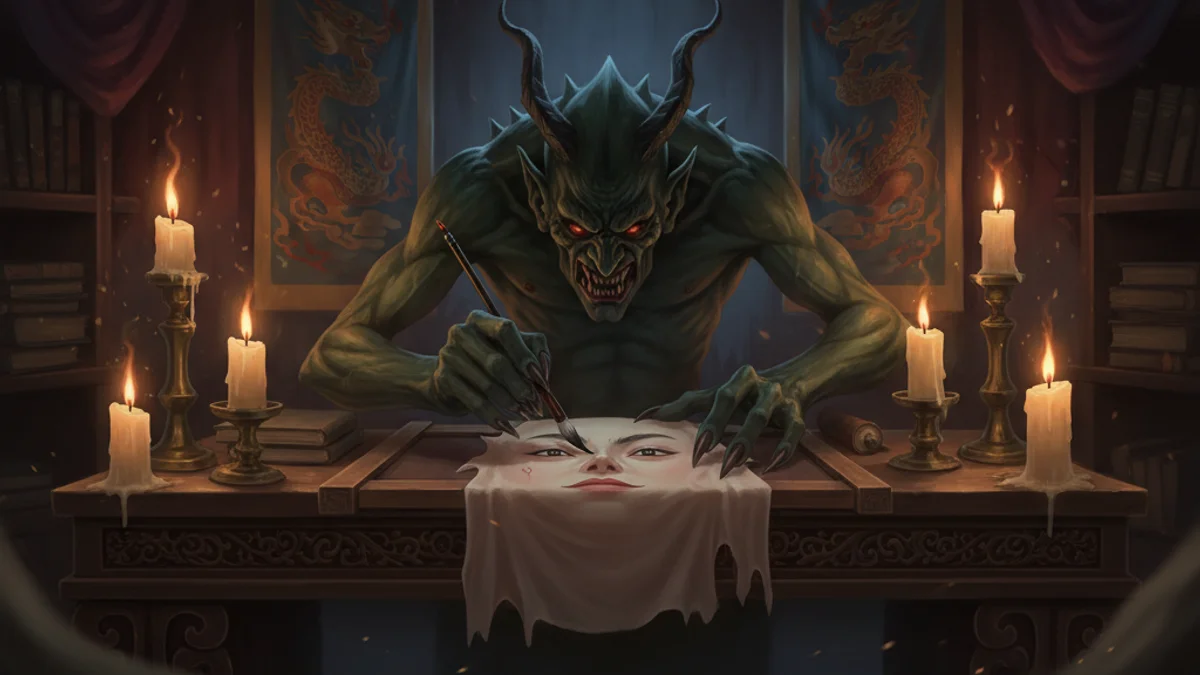
Scholar Wang Sheng encountered a beautiful maiden alone in the woods. Captivated by her elegance, he ignored the warnings of a passing Taoist priest and hid her in his study. One night, spurred by suspicion, Wang peeked through the window. To his horror, he saw a hideous, green-faced demon hunched over a bed, meticulously painting a human skin with a fine brush to resemble the girl. The demon, realizing its cover was blown, burst into Wang's room and tore out his heart. Wang's devoted wife, Chen, sought help from a mad beggar in the marketplace to save him. After enduring the beggar's mockery and swallowing his spit, she returned to Wang’s corpse. In a moment of grief, she vomited up a new, glowing heart that settled into her husband's chest, restoring his life. The demon was eventually vanquished by the priest’s wooden sword, leaving behind only the empty, painted skin.
Do not be deceived by outward appearances or superficial beauty, for a mask can hide a predatory heart.
Questions about this story
What is the moral of The Painted Skin (Extended)?
The moral is that internal character is more important than external appearance. It warns against being blinded by lust or superficial charm, as these can lead to ruin.
Who is the author of the original story?
The story was written by Pu Songling, a Qing Dynasty writer. It is part of his famous collection 'Strange Tales from a Chinese Studio' (Liaozhai Zhiyi).
How does Wang Sheng die in the story?
After Wang Sheng discovers the demon's true form, the creature attacks him. It rips open his chest and devours his heart, leaving him dead on the floor.
What is the significance of the mad beggar?
The beggar represents a test of humility and devotion. By accepting his humiliation, Wang's wife proves her selfless love, which provides the magic needed to restore her husband's life.
Advertisement
Good night.
