
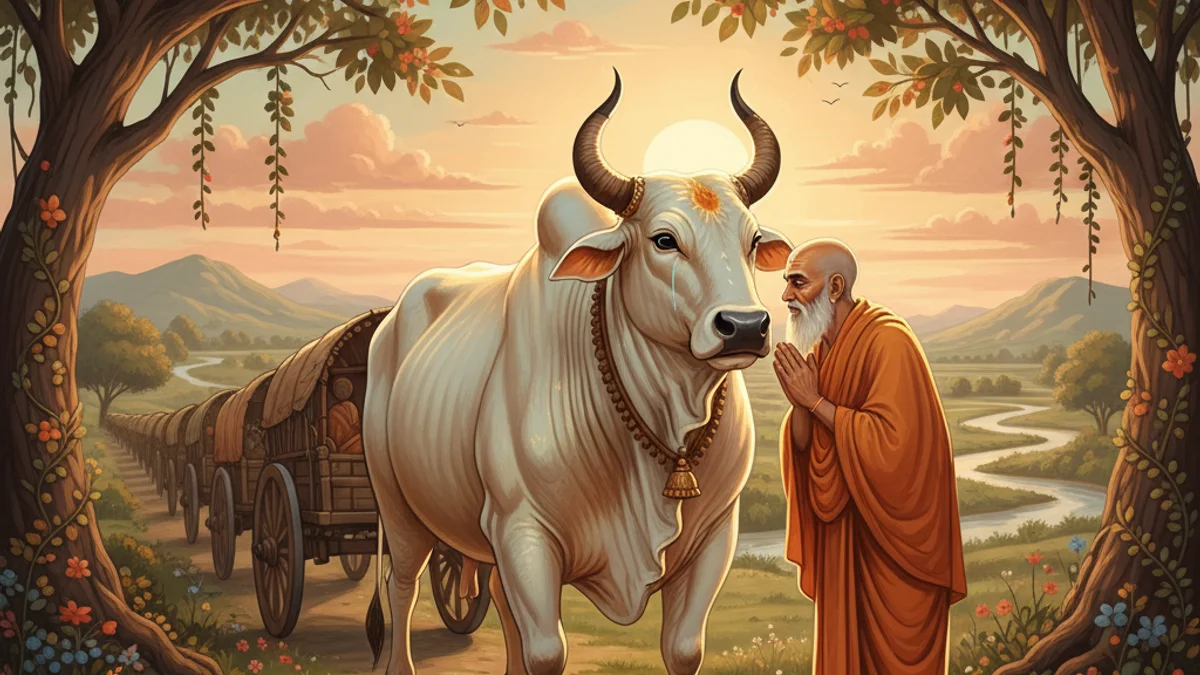
Long ago, the Bodhisatta was born as a powerful bull named Nandivisala. He was raised by a poor Brahmin who treated him with great care. Grateful for his master’s kindness, Nandivisala suggested a wager to help the Brahmin earn wealth: he could pull a hundred heavily loaded wagons. The Brahmin challenged a wealthy merchant to a bet of one thousand gold pieces. On the day of the trial, however, the Brahmin became arrogant. He whipped the air and shouted, 'Pull, you rascal! Move, you wretched beast!' Hurt and offended by these insults, Nandivisala stood perfectly still, refusing to move an inch, and the Brahmin lost his gold. Seeing his master’s despair, the bull later explained that he only failed because of the harsh words. They doubled the bet for a second trial. This time, the Brahmin spoke softly, saying, 'Go forth, my fine fellow! Pull, my noble bull!' Heartened by the kindness, Nandivisala pulled the heavy wagons with ease, winning the bet and teaching his master that gentle speech is the greatest strength.
Kindness and gentle words achieve far more than harshness and insults.
Questions about this story
What is the moral of The Ox's Patience?
The moral is that gentle speech and kindness are more effective than harshness. It teaches that respect and positive reinforcement build cooperation, while insults lead to failure.
Who was the ox in the Jataka Tales?
The ox, named Nandivisala, was a previous incarnation of the Bodhisatta, the being who would eventually become Gautama Buddha. He possessed great strength and wisdom.
Why did Nandivisala refuse to pull the carts the first time?
He refused because his master, the Brahmin, insulted him by calling him a 'rascal' and a 'wretched beast.' The bull felt that since he had never done anything wrong, he did not deserve such harsh language.
What did the Brahmin learn from his bull?
The Brahmin learned that even animals respond to the tone of one's voice. He realized that arrogance and cruelty are self-defeating, while humility and kindness yield the best results.
Advertisement


Good night.
