
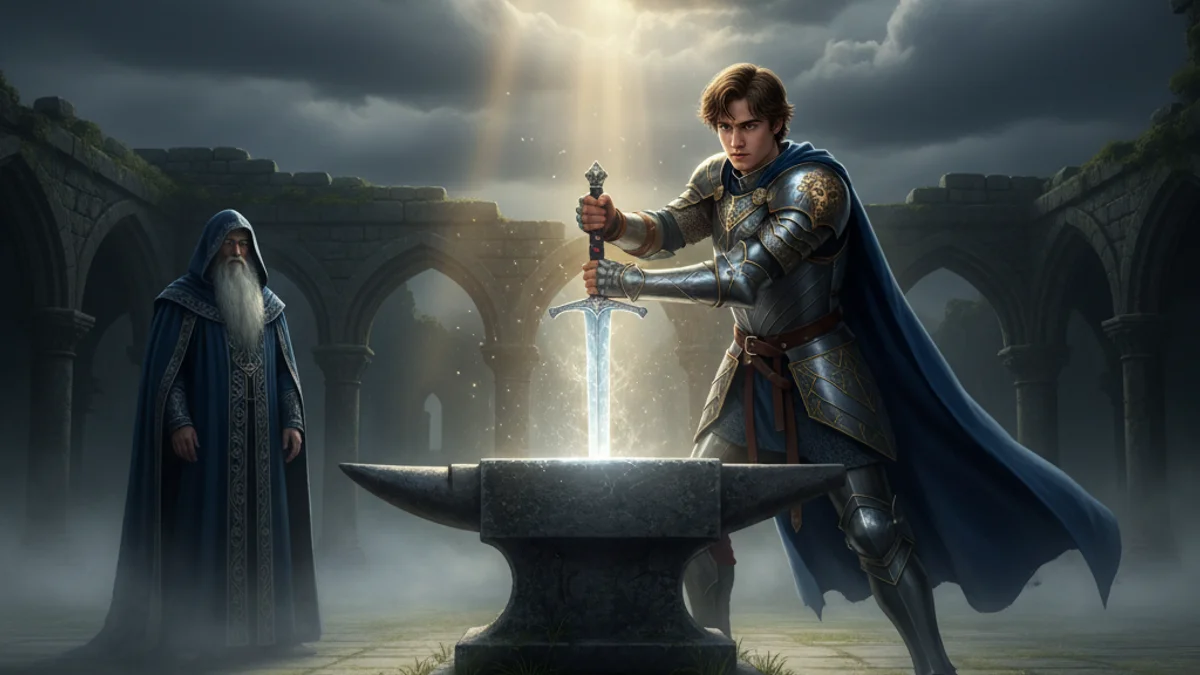
In a Britain torn by chaos, a young squire named Arthur, known as 'the Wart,' served his foster brother Kay. During a tournament in London, Arthur found himself without a sword for Kay and, seeing a blade embedded in an anvil atop a stone in a churchyard, easily drew it out. Unknown to him, the inscription declared that whoever pulled the sword was the rightful King of all Britain. Guided by the wise wizard Merlin, Arthur ascended the throne not to rule with an iron fist, but to establish a new order of chivalry. He created the Round Table, where all knights sat as equals, dedicated to the philosophy of 'Might for Right.' Though his reign faced betrayal from those he loved and the eventual rise of his son Mordred, Arthur’s vision transformed a dark age into a golden era of justice. Even as he was carried away to the mystical isle of Avalon after his final battle, the prophecy remained: he is the king who was, and the king who will come again when his country needs him most.
True leadership is found in using power to serve justice and the common good, rather than using strength for personal gain.
Questions about this story
What is the moral of The Once and Future King?
The core moral is that power should be used to uphold justice and 'Might for Right.' It teaches that a true leader seeks to build a civilization based on law and equality rather than brute force.
What does the title The Once and Future King mean?
The title refers to the legend that King Arthur did not truly die, but was taken to Avalon to heal. It suggests he will return to lead his people again in their hour of greatest need.
Is the Sword in the Stone the same as Excalibur?
In many versions, including T.H. White's, they are distinct. The Sword in the Stone proved Arthur's royal lineage, while Excalibur was later given to him by the Lady of the Lake for use in battle.
Why did King Arthur create the Round Table?
Arthur created the Round Table so that none of his knights could claim precedence over the others. It symbolized a community of equals dedicated to the service of the realm and the code of chivalry.
Advertisement
Good night.
