
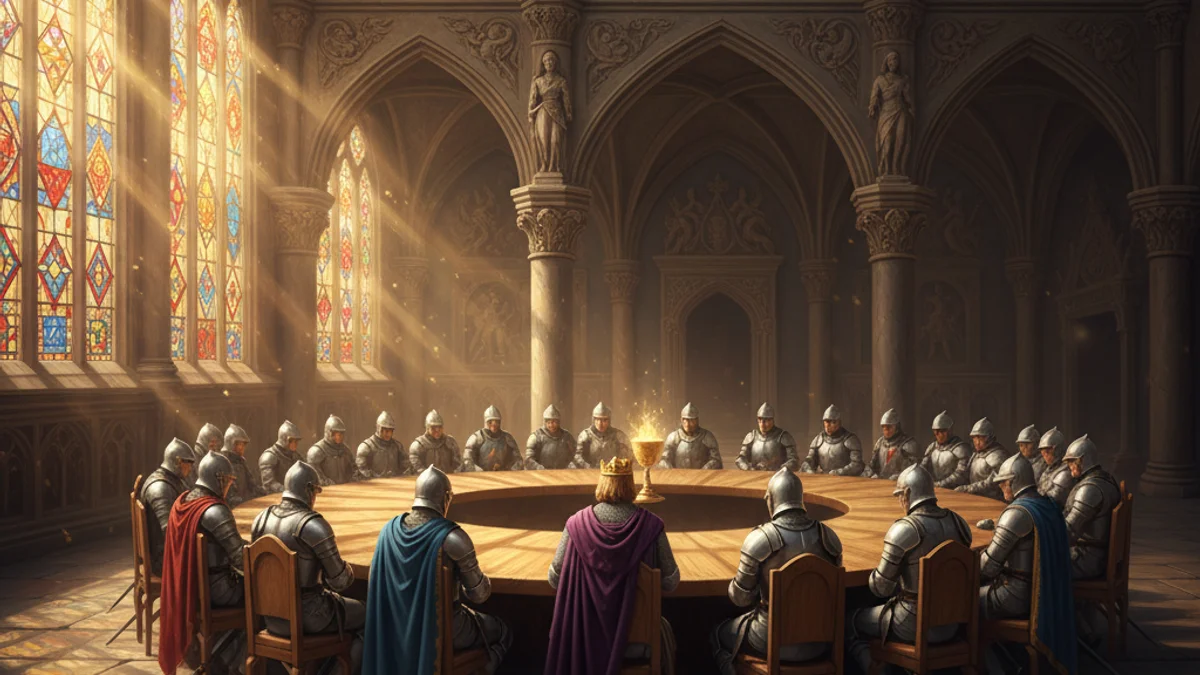
King Arthur sought to unite the fractured lands of Britain through peace and justice. Upon his marriage to Guinevere, her father, King Leodegrance, gifted Arthur a massive circular table that had once belonged to Uther Pendragon. Guided by the wisdom of the wizard Merlin, Arthur used this table to gather the greatest knights in the world. Its round shape was deliberate: it had no head and no foot, ensuring that every man who sat there—from the King himself to the youngest knight—was an equal. This fellowship, bound by a sacred code of chivalry, transformed Camelot into a beacon of hope. It proved that true strength lies in unity and mutual respect rather than rigid hierarchy, as the knights swore to protect the weak and uphold the law together.
True leadership is built on equality and the understanding that every voice carries equal weight in the pursuit of justice.
Questions about this story
What is the moral of The Round Table?
The moral is that equality and unity are essential for a just society. By removing the 'head' of the table, Arthur showed that every knight's contribution was vital to the kingdom's success.
Who gave the Round Table to King Arthur?
The table was a wedding gift from King Leodegrance, the father of Queen Guinevere. It originally belonged to Arthur's father, Uther Pendragon, before being entrusted to Leodegrance for safekeeping.
How many knights could sit at the Round Table?
The number varies by literary source, ranging from as few as 12 in early poems to 150 in Thomas Malory's famous work. Regardless of the number, the circular shape remained the primary symbol of their fellowship.
What does the Round Table symbolize?
It symbolizes equality, chivalry, and the shared purpose of the knights. Because there is no top or bottom, it represents a brotherhood where even the King is a peer among his soldiers.
Advertisement
Good night.
