
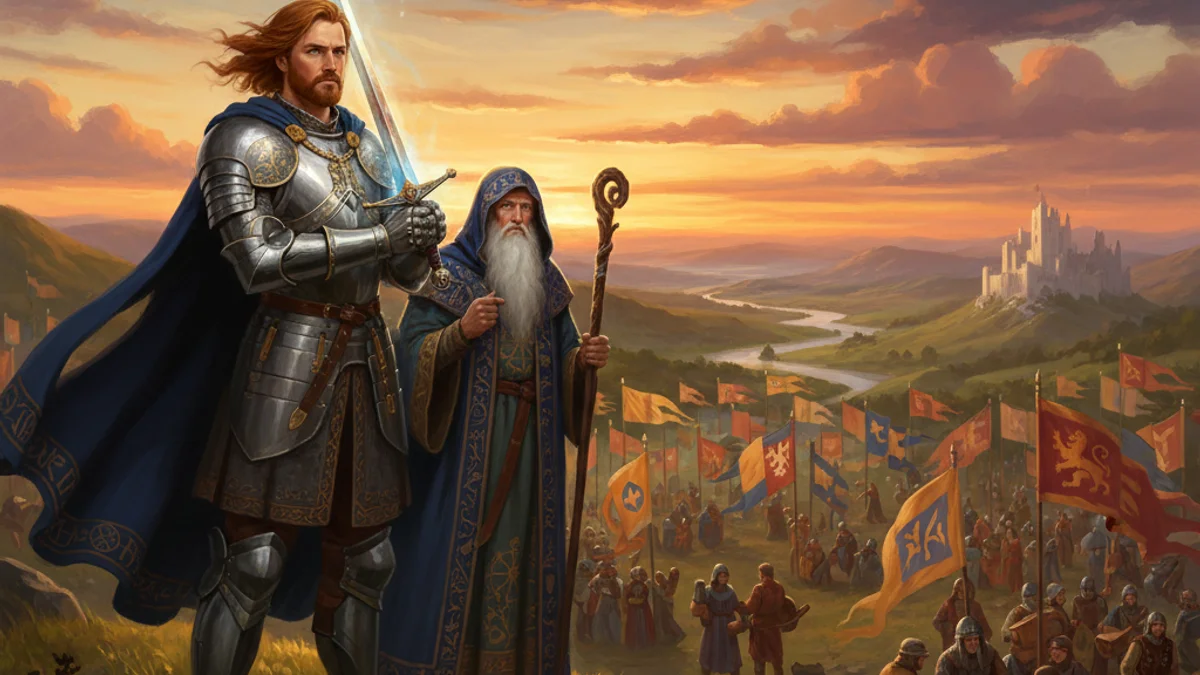
After pulling the sword from the stone, young Arthur was crowned King, yet the land remained fractured. Warlords and petty kings refused to acknowledge a boy-king's authority, plunging Britain into chaos. Guided by the wizard Merlin, Arthur did not merely seek conquest through force, but through a vision of a unified realm. He gathered the greatest knights to a Round Table, where every seat was equal, signaling an end to the petty hierarchies that fueled civil war. Through a series of strategic battles against the invading Saxons and rebellious lords, culminating in the great victory at Mount Badon, Arthur demonstrated both his prowess and his mercy. By offering peace to his defeated enemies and establishing a code of chivalry, he transformed a collection of warring tribes into a single, cohesive nation. Under his rule, the rule of law replaced the rule of the sword, and for a golden age, Britain breathed as one.
True leadership is found in creating equality and unity rather than ruling through fear and division.
Questions about this story
What is the moral of Arthur Unites Britain?
The moral is that collective strength and justice are more powerful than individual ambition. It teaches that a true leader works to bring people together for a common good rather than simply seeking power.
How did Arthur convince the other kings to follow him?
Arthur used a combination of military victory, divine right proven by the sword in the stone, and the promise of a fair government represented by the Round Table. He showed mercy to defeated foes, which earned their loyalty.
What role did Merlin play in uniting Britain?
Merlin served as Arthur's primary advisor and strategist, providing the wisdom and magical foresight needed to navigate political alliances. He was instrumental in conceptualizing the Round Table to ensure peace among the knights.
What was the significance of the Round Table?
The Round Table was significant because its shape meant there was no 'head,' making all knights who sat there equal. This prevented internal squabbling over status and focused the knights on protecting the realm.
Advertisement


Good night.
