
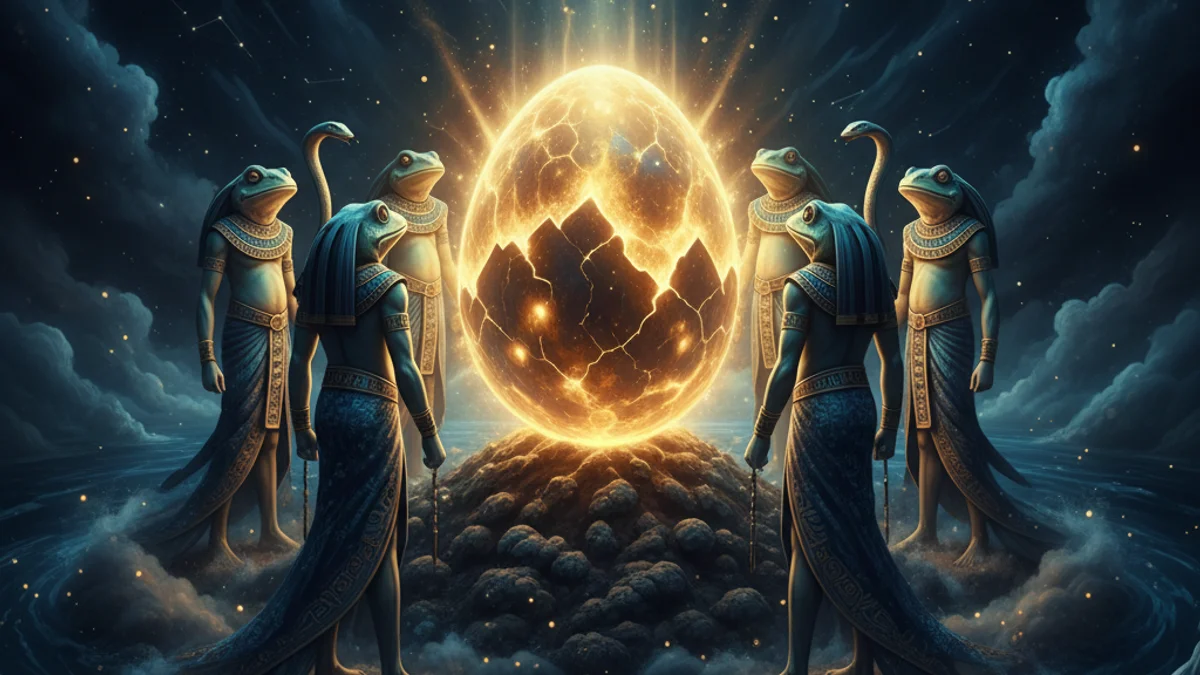
Before the world took shape, there existed only the dark, primordial waters of the Nun. Within this infinite chaos lived the Ogdoad: four pairs of frog-headed gods and serpent-headed goddesses representing the fundamental forces of the universe. Nu and Naunet represented the waters; Heh and Hauhet represented infinite space; Kuk and Kauket embodied the darkness; and Amun and Amaunet held the power of the hidden air. For eons, these eight forces swirled in the void until their energies converged at the city of Hermopolis. On a mound of earth known as the Isle of Flame, they combined their essences to create a celestial egg. From this vessel, the sun god Ra burst forth, flooding the void with light and bringing the first sunrise. His brilliance organized the chaos into the physical world, while the Ogdoad, having completed their cosmic duty, retreated to the underworld to maintain the eternal cycle of the universe.
Order and light are not found by destroying chaos, but by harmonizing the fundamental forces within it.
Questions about this story
What is the moral of The Ogdoad of Hermopolis?
The story teaches that balance and creation emerge from the convergence of opposing primordial forces. It suggests that even in total chaos, there is the potential for harmony and light if the right elements align.
Who were the eight gods of the Ogdoad?
The Ogdoad consisted of four pairs: Nu and Naunet (water), Heh and Hauhet (infinity), Kuk and Kauket (darkness), and Amun and Amaunet (hiddenness). Each pair consisted of a male deity, often depicted as a frog, and a female deity, often depicted as a snake.
What is the significance of the city of Hermopolis?
Hermopolis, or Khmun, was the cult center of the Ogdoad and the god Thoth. It was believed to be the site of the 'Isle of Flame' where the world first began and the sun rose for the first time.
How does the Ogdoad differ from the Ennead?
The Ogdoad focuses on the eight primordial forces of chaos that preceded creation in Hermopolis. The Ennead is a separate creation myth from Heliopolis focusing on nine gods, starting with Atum and moving through his descendants like Osiris and Isis.
Advertisement
Good night.
