
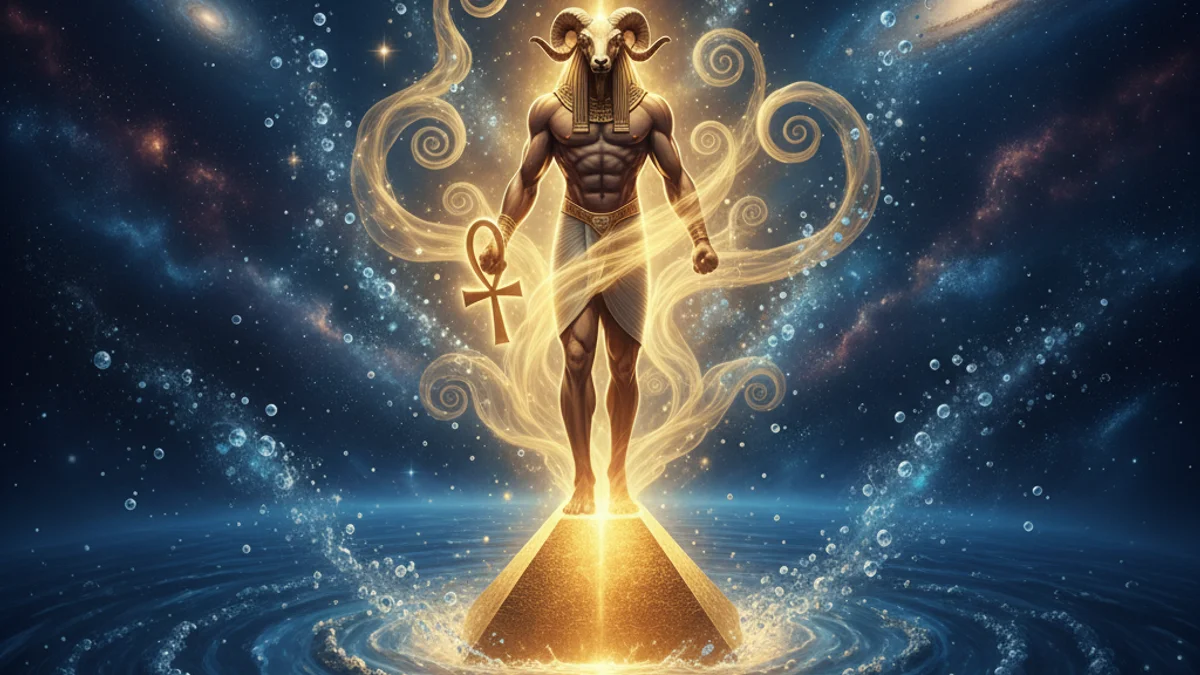
Before the world had form, there was only the Nun—a vast, dark, and silent expanse of primordial water. From this chaos, the god Atum willed himself into being by speaking his own name. He rose upon the Benben, the first mound of dry earth to emerge from the depths. Standing alone in the void, Atum contained all the potential of the universe. To populate the world, he produced the first divine couple: Shu, the god of air, and Tefnut, the goddess of moisture. When these children became lost in the darkness of the Nun, Atum sent his divine eye to find them. Upon their safe return, Atum was so moved that he wept; his tears fell upon the newly formed earth and transformed into the first human beings. Shu and Tefnut eventually gave birth to Geb, the earth, and Nut, the sky, establishing the physical boundaries of the Egyptian cosmos and the lineage of the Great Ennead.
The universe is an interconnected web of life born from the singular will to create order out of chaos.
Questions about this story
What is the moral of Atum Creates the Gods?
The story emphasizes that order and life originate from a single source of divine will and emotional connection. It teaches that the universe is an interconnected family born from the unity of a creator and the balance of natural elements.
Who is Atum in Egyptian mythology?
Atum is a primordial creator deity, often associated with the setting sun and considered the 'Complete One.' He is the first god of the Ennead who emerged self-created from the watery chaos of Nun at the dawn of time.
How did Atum create Shu and Tefnut?
According to the Heliopolitan myth, Atum created Shu, the god of air, and Tefnut, the goddess of moisture, through his own essence, often described as spitting or sneezing them out. This act represents the first division of the singular creator into the dualities of the physical world.
What is the significance of the Benben mound?
The Benben is the primordial hill that first rose from the waters of Nun. It served as the physical foundation for all creation and inspired the pyramidal shape of tomb capstones and the tops of obelisks in Egyptian architecture.
Advertisement
Good night.
