
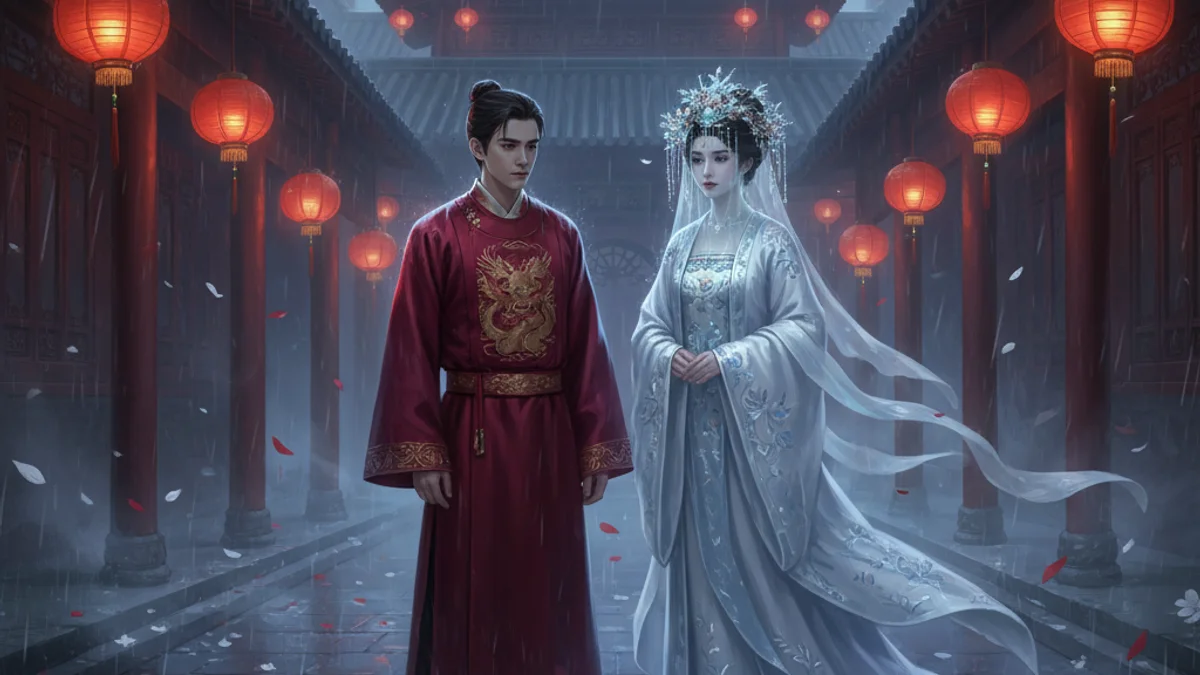
Li Wei, a humble scholar traveling through a remote village, happened upon a red silk envelope lying on a dusty path. Upon picking it up, he was immediately surrounded by the servants of a wealthy estate. They informed him that by taking the envelope, he had accepted a dowry and agreed to marry their master’s deceased daughter, Mei Ling. This was the ritual of Minghun, a spirit marriage intended to provide a spouse for those who died young. Li Wei was led to a somber, candlelit hall where a wooden tablet stood in place of a living bride. As the dark ceremony reached its climax, the air grew unnaturally cold. The pale, ethereal figure of Mei Ling appeared beside him, draped in ornate red bridal silks. She whispered that his kindness had saved her soul from eternal loneliness. Though Li Wei eventually returned to his life, he was never truly alone; a soft, ghostly hand would often rest in his, and the scent of jasmine followed him until his final days, marking a bond that even death could not sever.
Promises and traditions, even those made unwittingly, carry a weight that transcends the physical world.
Questions about this story
What is a spirit marriage in Chinese culture?
A spirit marriage, or 'Minghun,' is a traditional practice where one or both parties are deceased, intended to ensure that the dead are not lonely in the afterlife.
Why would a living person marry a ghost?
In folklore, it often happens through trickery, such as picking up a red envelope, or as a way for a family to fulfill a debt or social obligation.
Is The Ghost Bride a true story?
While based on the real historical practice of spirit marriage, the specific story of The Ghost Bride is a popular folk legend found in various forms across East Asian literature.
What happens to the living spouse in these legends?
The living spouse is often said to be blessed with good fortune or protection by the spirit, though they are forever tethered to the spiritual realm.
Advertisement
Good night.
