
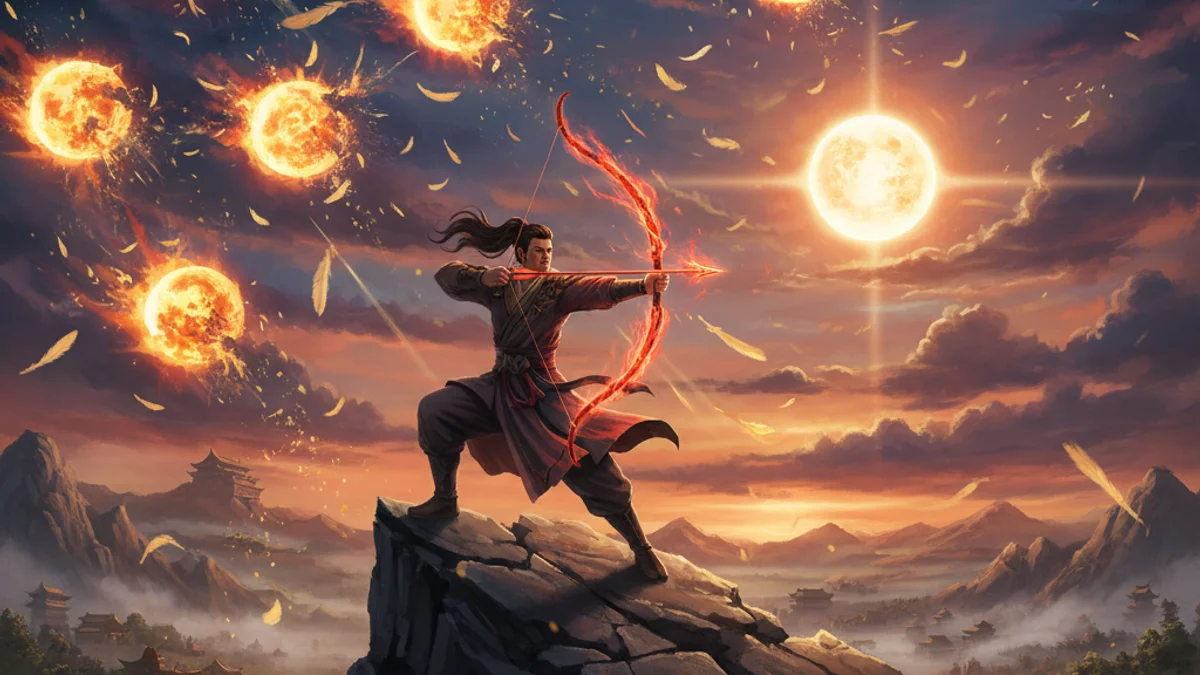
Long ago, in the dawn of time, ten suns lived in a giant mulberry tree. These suns were the sons of the Jade Emperor and were meant to take turns crossing the sky. However, one day, they grew bored and decided to rise all at once. The heat became unbearable; rivers dried up, crops turned to ash, and the people suffered in agony. Seeing the devastation, the legendary archer Houyi was summoned to save the world. Armed with a divine red bow and white arrows, he climbed to the top of a high mountain. With incredible precision, he began shooting down the suns one by one. As each arrow struck, a sun transformed into a three-legged golden crow and fell to earth. When only one sun remained, Houyi stopped, realizing that the world still needed light and warmth to survive. The earth cooled, life returned to the fields, and Houyi was hailed as a hero for restoring balance to the heavens.
Great skill and power are most noble when used to protect others and restore balance to the world.
Questions about this story
What is the moral of Houyi Shoots the Suns?
The story emphasizes that power should be used for the benefit of humanity rather than personal gain. It also teaches the importance of moderation and balance, as Houyi left one sun to ensure the world had light without being destroyed.
Why were there ten suns in the sky?
In Chinese mythology, the ten suns were the children of the Jade Emperor and the sun goddess Xihe. They were supposed to appear one at a time, but they decided to appear together out of playfulness and rebellion.
What happened to the suns that Houyi shot down?
As Houyi's arrows struck the suns, they transformed into three-legged golden crows and fell to the earth. These crows are traditional symbols of the sun in East Asian mythology.
Why did Houyi leave one sun remaining?
Houyi realized that if he shot down all ten suns, the world would be left in eternal darkness and cold. He left the final sun so that plants could grow and humans could have warmth and daylight.
Advertisement
Good night.
