
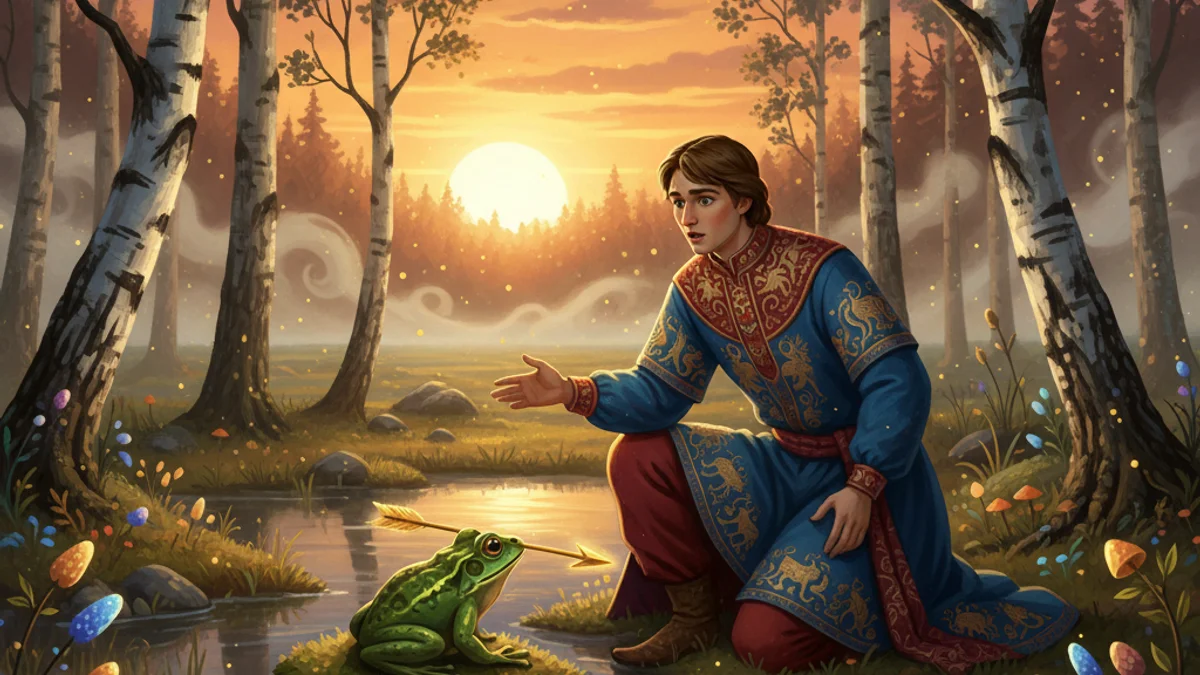
A Tsar ordered his three sons to shoot arrows into the world, vowing they would marry wherever their arrows landed. The eldest’s arrow fell in a nobleman’s yard, and the second’s in a merchant’s. But Prince Ivan’s arrow flew into a murky swamp, where it was retrieved by a common frog. Bound by his father’s decree, Ivan married the creature. During the Tsar's challenges for the new brides, the frog secretly transformed into Vasilisa the Wise, a brilliant sorceress, performing miracles that outshone the others. Eager to keep her human form forever, Ivan found her frog skin and burned it. Vasilisa wept, explaining that had he waited three more days, she would have been free. She vanished to the realm of Koschei the Deathless. Ivan embarked on a perilous quest, aided by Baba Yaga and several forest animals he spared. He eventually found Koschei's soul hidden in a needle, broke it to kill the sorcerer, and rescued his beloved princess.
True beauty and wisdom are often hidden beneath a humble surface, and patience is essential when dealing with things we do not fully understand.
Questions about this story
What is the moral of The Frog Princess?
The story teaches that beauty is found within and that patience is a virtue. Ivan’s impatience in burning the skin caused him great suffering, showing that one must respect a partner's secrets and timing.
Who is Vasilisa the Wise?
Vasilisa the Wise is a powerful sorceress and the heroine of the tale. She is often depicted as more capable and magical than the prince, having been cursed to live as a frog by her father.
Why did Prince Ivan burn the frog skin?
Ivan burned the skin because he was ashamed of his wife's frog form and wanted her to remain a beautiful woman permanently. He did not realize that by doing so, he was actually extending her curse and forcing her to flee.
How is this story different from The Frog Prince?
While the Western 'Frog Prince' features a male frog and a princess, the Slavic 'Frog Princess' features a female frog and a prince. The Slavic version is also much longer, involving an epic quest and battles against dark sorcerers.
Advertisement


Good night.
