
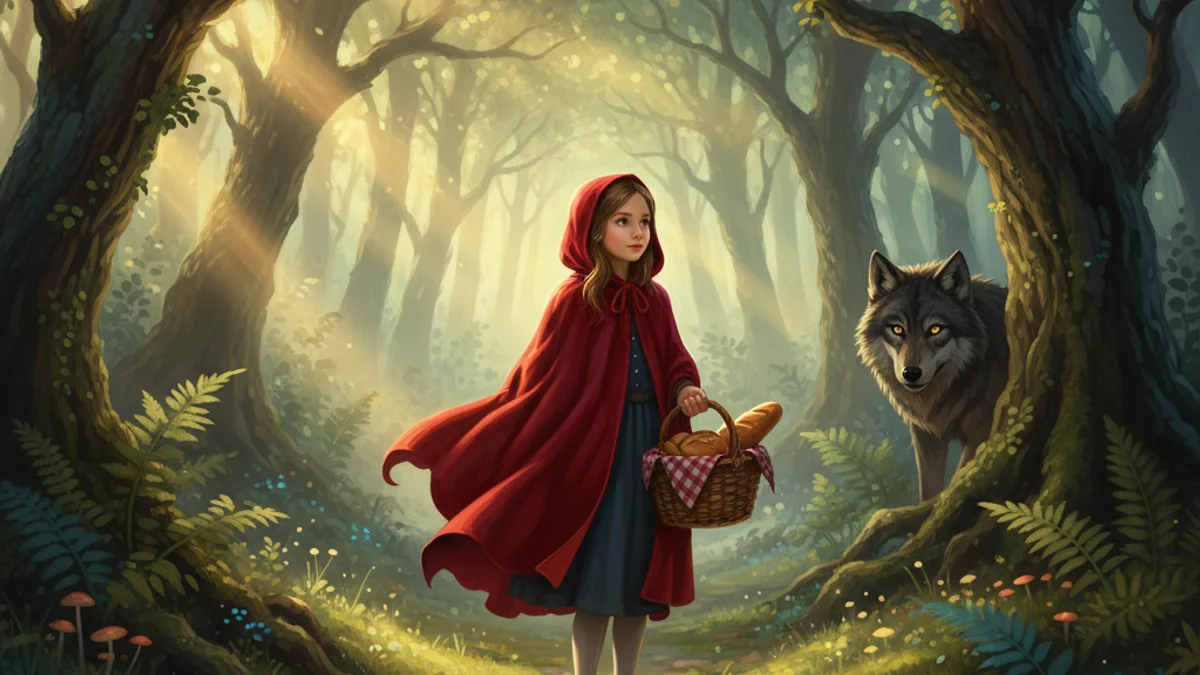
Once, a sweet young girl lived near a dark forest, known by all as Little Red Riding Hood for the velvet cloak her grandmother gave her. One day, her mother asked her to take cake and wine to her ailing grandmother, warning her to stay on the path. In the woods, she met a cunning wolf. Unaware of his malice, she told him her destination. The wolf raced ahead, devoured the grandmother, and disguised himself in her nightclothes. When the girl arrived, she questioned her grandmother's strange appearance, eventually exclaiming, 'What big teeth you have!' The wolf replied, 'The better to eat you with!' and swallowed her whole. A passing huntsman heard the wolf's snoring, cut open the beast to rescue the girl and her grandmother, and filled the wolf's belly with heavy stones, ending his terror forever.
The story warns children to never stray from the safety of the path and to be wary of charming strangers who may have hidden, dangerous intentions.
Advertisement
Questions about this story
What is the moral of Little Red Riding Hood?
The primary moral is to stay on the designated path and avoid talking to strangers. It teaches children that predators can be deceptive and that following parental instructions is vital for safety.
Who wrote the original Little Red Riding Hood?
While it originated as an oral folk tale, the most famous written versions are by Charles Perrault in 1697 and the Brothers Grimm in 1812. The Grimm version added the happy ending featuring the huntsman.
What did Little Red Riding Hood have in her basket?
In the Brothers Grimm version, she was carrying a piece of cake and a bottle of wine. These items were intended to help her grandmother recover from an illness and regain her strength.
How did the huntsman save the grandmother?
The huntsman found the wolf sleeping and, realizing it had eaten the grandmother, used a pair of scissors to cut open the wolf's belly. This allowed both the girl and her grandmother to emerge unharmed.
Advertisement

