
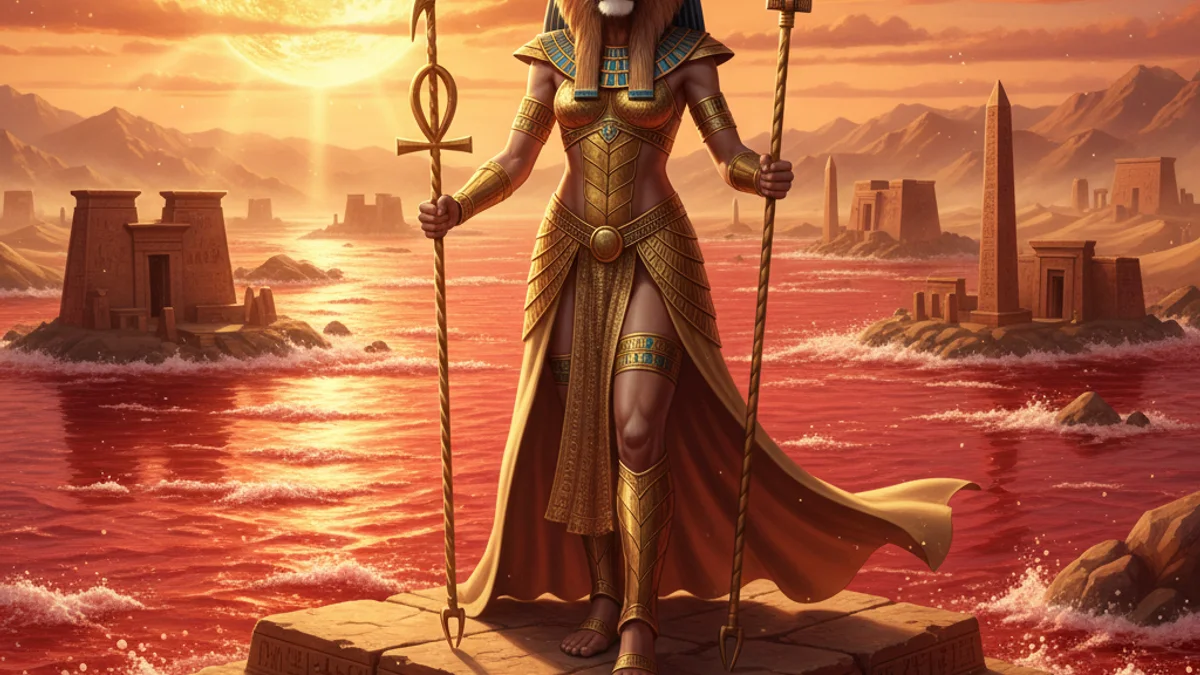
As the sun god Ra grew old, his bones turning to silver and his flesh to gold, the people of Egypt began to plot against him, mocking his waning strength. Discerning their treachery, Ra summoned a secret council of the eldest gods in the primeval waters of Nun. Upon their advice, he unleashed his 'Eye'—the goddess Hathor—in the form of the ferocious lioness Sekhmet. She descended upon the rebels, slaughtering them until the desert sands turned to crimson mire. However, the goddess’s bloodlust became insatiable, threatening to consume every living soul. Seeing that his creation would be utterly extinguished, Ra felt pity. He commanded his messengers to prepare seven thousand jars of beer mixed with red ochre to mimic the color of blood. They flooded the fields of Dendera with the brew. When Sekhmet arrived to continue her massacre, she saw the red liquid and drank greedily. Intoxicated and pacified, she fell into a deep slumber, forgetting her wrath. Thus, humanity was spared, though the bond between the gods and men was forever changed.
Unchecked vengeance leads to total ruin, and even the most righteous anger must be tempered with mercy and wisdom.
Questions about this story
What is the moral of The Destruction of Mankind?
The myth teaches that while rebellion against divine order has consequences, extreme retribution can become self-destructive. It emphasizes the necessity of compassion and the clever use of intellect to curb mindless violence.
Why did Ra want to destroy mankind?
Ra sought to punish humanity because they had grown disrespectful and were plotting against him as he aged. He felt his authority as the creator was being undermined by their insolence.
How did Ra save the remaining humans?
Ra saved humanity by tricking Sekhmet with 7,000 jars of beer dyed red to look like blood. She drank the mixture, became intoxicated, and fell asleep before she could kill everyone left.
What is the relationship between Hathor and Sekhmet?
In this myth, they are two sides of the same deity. Hathor is typically the goddess of love and joy, but when Ra unleashed her fury, she transformed into the destructive lioness Sekhmet.
Advertisement
Good night.
